 Atlas of China
Shaoxing 绍兴Shàoxīng
Rice wine, black-awning boats and the birthplace of Yue opera
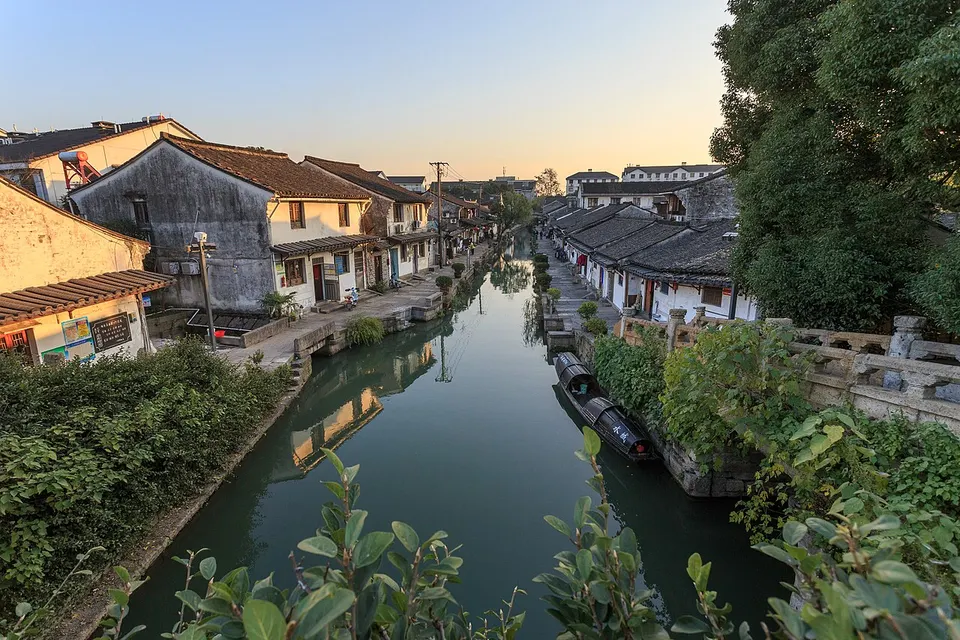
About Shaoxing
Shaoxing was the capital of the state of Yue some 2,500 years ago, and black-awning boats still ply its canals under stone bridges such as Bazi Bridge. The writer Lu Xun grew up here, and his family home stands in the old town, as does the Shen Garden, linked with the love story of the Song poet Lu You. Outside the city are the Orchid Pavilion, where the calligrapher Wang Xizhi wrote his celebrated preface in 353, and the Mausoleum of Yu the Great.
What to eat in Shaoxing
- Shaoxing rice wine (绍兴黄酒)
- Aniseed broad beans (茴香豆)
- Shaoxing stinky tofu (绍兴臭豆腐)
Listed sites in Shaoxing
33 sites in Shaoxing are on the official lists. Those with a page of their own link to it; the rest open as cards on the map.
- Lu Xun Native Place & Shen Garden 鲁迅故里·沈园 5A scenic area · National heritage site
The block on Lu Xun Middle Road where the writer Lu Xun (Zhou Shuren) was born in 1881 and grew up until 1898, now a historic quarter taking in his ancestral home, the family's New Taimen house with the Baicao Garden behind it, the Sanwei Study across the canal where he went to school, and the Shaoxing Lu Xun Memorial Hall, first opened in 1953. - Anchang Ancient Town 安昌古镇 4A scenic area · on the map
An old canal town in northern Keqiao, named in the late Tang and listed among China's historic and cultural towns in 2005, with cobbled lanes and black-awning boats on its waterways. - Chuanyan Nineteen Peaks 穿岩十九峰 4A scenic area · on the map
A scenic area of red sandstone cliffs in Jingling town, south-west Xinchang, named after a row of nineteen peaks that rise above the meeting of several mountain streams. - Dafo Temple, Xinchang 新昌大佛寺 4A scenic area · National heritage site
A Buddhist temple in the Shicheng hills on the edge of Xinchang town, founded in 345, whose great hall encloses a seated stone Maitreya carved into the cliff of Xianji Rock and completed in 516 after the work of three successive monks. - Dali Silk World, Xinchang 达利丝绸世界 4A scenic area · on the map
An industrial-tourism site at the works of Dali Silk, a silk textile and garment maker in Xinchang, which the company began developing around the theme of silk in 2007. - Daxianglin and Doushuaitian 大香林·兜率天 4A scenic area · on the map
A Buddhist-themed scenic area in Hutang, Keqiao, at the western end of the Kuaiji hills, known for more than 400 mu (about 27 hectares) of sweet osmanthus trees, among them one over 1,000 years old that is billed as the 'King of Chinese Osmanthus'. - East Lake, Shaoxing 东湖 4A scenic area
A small lake on the eastern edge of Shaoxing that fills an old quarry: from the Han dynasty onwards masons cut away half of a hill of grey stone, leaving sheer cliffs and deep pools, which the late-Qing local scholar Tao Junxuan enclosed with a long dyke and laid out as a garden. - Fuzhi Mountain 覆卮山 4A scenic area · on the map
A mountain of the Siming range where Shangyu, Shengzhou and Yuyao meet, rising to about 860 m as the highest point in Shangyu; its name, 'the upturned wine cup', comes from a line by the fifth-century poet Xie Lingyun, who wrote of drinking and composing poems on the mountain, then turning his cup over. - Keyan Scenic Area 柯岩 4A scenic area · National heritage site
A scenic area of about 6.9 km² west of Shaoxing made up of three parts: the rocks of Ke hill, a stretch of Jian Lake and Luzhen, a water-town quarter. - Mausoleum of Yu the Great 大禹陵 4A scenic area · National heritage site
The traditional burial place of Yu the Great, the legendary tamer of floods and founder of the Xia dynasty, at the foot of Kuaiji Mountain south-east of Shaoxing. - Orchid Pavilion (Lanting) 兰亭 4A scenic area · National heritage site
The garden at the foot of Lanzhu hill where, in 353, the calligrapher Wang Xizhi and more than forty friends held a spring gathering, floating cups of wine down a winding stream and writing poems, for which he wrote the Preface to the Orchid Pavilion Poems, the most celebrated work of Chinese running script. - Oriental Neverland (Kuwan Town) 东方山水乐园 4A scenic area · on the map
An amusement-park complex in Keqiao, listed together with the surrounding 'Kuwan Town' leisure development, made up of the indoor Mountain Kingdom, the outdoor Coldplay Kingdom (Kuwan Wangguo) with several roller coasters including an inverted coaster, and a water park. - Qiaobo Ice and Snow World 乔波冰雪世界 4A scenic area · on the map
An indoor ski centre beside the Keyan scenic area in Keqiao, founded by the former speed-skating world champion Ye Qiaobo, where a refrigerated hall with artificial snow allows skiing and snowboarding all year round. - Wuxie Scenic Area 五泄 4A scenic area · on the map
A hill scenic area in Wuxie town, in the north-west of Zhuji, named after a chain of five waterfalls, counted from the first to the fifth, that step down a forested gorge. - Xi Shi's Hometown (Xishi Guli) 西施故里 4A scenic area · on the map
A tourist area of about 1.44 km² on both banks of the Huan River at the foot of Zhuluo hill in Zhuji, built by the city from 2003 around the legendary home of Xi Shi, one of the Four Beauties of ancient China. - Ancient Towpath, Keqiao 古纤道 National heritage site
A stone towpath along the Eastern Zhejiang Canal from which boats were hauled by men on foot, first worn along the banks after the canal was dug in the Western Jin and rebuilt in stone in the Hongzhi reign of the Ming (1488–1505). - Angsang Lake Causeway 昂桑湖避塘 National heritage site
A stone causeway about 3.5 km long that winds north–south across Angsang Lake on the northern edge of Shaoxing, built in the late Ming and finished after 1642 so that boats could shelter from wind and waves, while also linking the two shores. - Bazi Bridge 八字桥 National heritage site
A stone beam bridge in the eastern part of Shaoxing's old city, rebuilt in 1256, whose stepped approaches split at both ends so that the bridge is shaped like the character 八 ('eight'); it is the only known early example of this form among China's simple beam bridges. - Cao'e Temple 曹娥庙 National heritage site
A temple on the west bank of the Cao'e River honouring Cao E, an Eastern Han girl who drowned in the river trying to save her father and became a model of filial piety; she was reburied here with a memorial stele in 151, and a shrine grew up around her grave. - Chongren Old Town 崇仁古镇 National heritage site · on the map
A village-town in western Shengzhou, settled before the Three Kingdoms, which became the home of the Qiu clan after they moved here in the 1040s and keeps more than 200 buildings from the early Ming to the Republic, among them 154 old courtyard gates (taimen), 14 tea and road pavilions and 51 old wells. - Chunhui Middle School Old Campus, Baima Lake 春晖中学旧址 National heritage site · on the map
A private secondary school on the shore of Baima Lake, paid for by the merchant Chen Chunlan and opened in 1922 under the educator Jing Hengyi, where writers and artists such as Zhu Ziqing, Xia Mianzun, Feng Zikai and Zhu Guangqian taught in the 1920s; it pioneered co-education among Zhejiang's secondary schools. - Dashan Pagoda 大善塔 National heritage site
A hexagonal, seven-storey brick pagoda 40.5 m tall in the centre of Shaoxing, named after Dashan Temple, founded in 504, in which it once stood. - Datong School and Xu Xilin's Former Residence 大通学堂 National heritage site · on the map
A school opened in 1905 in a former Qing granary by Xu Xilin and Tao Chengzhang of the anti-Qing Guangfuhui to train members of secret societies for an armed rising; after Xu left for Anhui it was run by Qiu Jin, who was arrested here on 13 July 1907 after Xu's failed Anqing uprising. - East Huacheng Temple Pagoda, Fengqiao 东化城寺塔 National heritage site
A brick pagoda built in 1092 on the Ziwei hill ridge just south-east of Fengqiao, named after the East Huacheng Temple that once stood in front of it and also called the Yuanyou Pagoda after the reign in which it was built. - Fenghuangshan Kiln Sites 凤凰山窑址群 National heritage site · on the map
A group of kilns on the hill slopes behind Dashan village in Shangpu, Shangyu, which fired early celadon for daily use and for burials during only fifty or sixty years, from the late Three Kingdoms to the end of the Western Jin in the third and early fourth centuries. - Former Residence of Cai Yuanpei 蔡元培故居 National heritage site
The birthplace of Cai Yuanpei (1868–1940), the educator who was president of Peking University and founder of the Academia Sinica, and earlier a leader of the anti-Qing Guangfuhui. - Jianchu Land-Purchase Inscription 汉建初元年买地刻石 National heritage site
A cliff inscription cut in AD 76 on the eastern slope of Tiao hill in Fusheng, recording in 20 characters that six brothers bought this hillside together as a burial ground, with the words 'Da Ji' ('great fortune') above. - Qingteng Studio (Xu Wei's Former Residence) 青藤书屋 National heritage site · on the map
The birthplace and study of Xu Wei (1521–1593), the Ming painter, calligrapher, poet and playwright whose free ink painting gave rise to the Qingteng school, named after one of his art names; the late Ming painter Chen Hongshou later lived here too. - Qiu Jin's Former Residence 秋瑾故居 National heritage site · on the map
The family home of the revolutionary and writer Qiu Jin at Hechangtang, on the south-west foot of Pagoda Hill, where she spent her girlhood and lived again from her return from Japan in 1906 until her execution in 1907. - Shunwang Temple 舜王庙 National heritage site · on the map
A temple on Shunwang hill in Wangtan town, southern Keqiao, dedicated to the legendary sage-king Shun, who by local tradition took refuge here from the unrest stirred up by Yao's son Danzhu. - Si Family Houses, Sizhai 斯氏古民居 National heritage site · on the map
Fourteen large houses from the Qing and Republican periods in Sizhai, a hill village in Dongbaihu town where the Si clan has lived since the Tang. - Wang Clan Ancestral Halls, Huatang 华堂王氏宗祠 National heritage site
Two ancestral halls in Huatang village, Jinting town, the seat of a Wang clan descended from the fourth-century calligrapher Wang Xizhi. - Yinshan Royal Tomb of Yue 印山越国王陵 National heritage site
The tomb of a king of the Spring and Autumn state of Yue, possibly Yunchang, father of King Goujian, cut into the top of Yin hill and ringed by a moat; excavated in 1996–98 after tomb robbers struck, it was the first Yue royal tomb found in China.
On the map
Open Shaoxing on the illustrated map to see its outline, its places and listed sites together, and to add them to a trip.
Open Shaoxing on the map