 Atlas of China
Xuchang 许昌Xǔchāng
Cao Cao's capital, tales of Guan Yu and the blue and purple glazes of Jun ware
About Xuchang
At the end of the Han, the warlord Cao Cao brought the last Han emperor to Xu, which became the dynasty's capital, and Three Kingdoms lore still marks the city: Chunqiu Tower recalls Guan Yu reading the Spring and Autumn Annals through the night, and Baling Bridge is where Cao Cao is said to have seen him off. Shenhou town in Yuzhou is the home of Jun ware, and Xuchang's wig makers sell their hairpieces around the world.
Listed sites in Xuchang
27 sites in Xuchang are on the official lists. Those with a page of their own link to it; the rest open as cards on the map.
- Baling Bridge Scenic Area 灞陵桥 4A scenic area · National heritage site
A park on the western side of Xuchang marking the place where, in Three Kingdoms legend, Guan Yu took his leave of Cao Cao and lifted the parting gift of a robe on the tip of his blade. - China Jun Porcelain Culture Park 中国钧瓷文化园 4A scenic area · on the map
A themed park on the north side of Yuzhou devoted to Jun ware, one of the celebrated Song-dynasty ceramics, laid out as a palace-style garden around Tiancheng Pavilion, a building about 50 m tall. - Chunqiu Tower Scenic Area 春秋楼 4A scenic area · National heritage site
A walled complex of Ming and Qing-style buildings in the centre of Xuchang's old city, built around the tower where, in Three Kingdoms lore, Guan Yu sat up at night reading the Spring and Autumn Annals while he was held by Cao Cao. - Dahongzhai Scenic Area 大鸿寨 4A scenic area · on the map
A national forest park of about 36 km² in the hills of north-western Yuzhou, named after Dahong, a minister of the legendary Yellow Emperor whom local tradition places here; its highest peak, Wofo Mountain, is 1,156 m. - Huadu Hot Spring Town 花都温泉小镇 4A scenic area · on the map
A hot-spring resort in Chenhuadian town, set among Yanling's flower nurseries, with geothermal bathing pools, a hotel and guesthouses. - Jianye Green Base 建业绿色基地 4A scenic area · on the map
A plant-growing and garden base among the nurseries of Yanling, promoted on the city's 2026 spring flower routes for its anthuriums and crab-apple blossom. - Jinyu Herb Manor 金雨香草庄园 4A scenic area · on the map
A herb-themed hot-spring resort in Yanling whose bathing pools are infused with fragrant herbs. - Shenhou Ancient Town 神垕古镇 4A scenic area
A pottery town in the hills south-west of Yuzhou where Jun ware has been made since the Tang and Song, and which is still full of working kilns, studios and showrooms. - Shoushan Scenic Area 首山 4A scenic area · on the map
A hill just south of Xiangcheng town, linked in legend with the Yellow Emperor, who is said to have mined copper here, and ringed by rapeseed fields whose spring flowering has drawn an annual festival since 2018. - Tangyun Eco-Tourism Area 唐韵生态旅游区 4A scenic area · on the map
A garden park among Yanling's plant nurseries that combines a cherry-blossom garden with courtyards, pavilions and colonnades built in Tang-dynasty style among flowering trees. - Wucai Dadi Flower Fields 五彩大地 4A scenic area · on the map
A sightseeing park of flower fields in the core of Yanling County's nursery-growing district, planned in 2015 and laid out from 2016 as part of the county's flower-tourism drive. - Yanling National Flower and Plant Expo Garden 鄢陵国家花木博览园 4A scenic area · on the map
A large landscaped garden in Yanling's new town, built in 2002 to show off the county's centuries-old nursery and flower trade, with themed areas for bamboo, wintersweet, bonsai, conifers and tropical plants. - Yuzhou Jun Kiln Site Museum 禹州钧官窑址博物馆 4A scenic area · National heritage site
A museum on the Juntai kiln site in Yuzhou, source of the 'official' Jun wares made for the imperial court, whose date (late Northern Song or early Ming) is still debated; the kilns were found in 1964 and excavated from 1974. - City Wall of Xiangcheng 襄城城墙 National heritage site
The western side of Xiangcheng's old county wall, the only part left after the south, east and north walls were pulled down between the Republican era and the 1970s. - Huaibang Guild Hall 怀邦会馆 National heritage site
A guild hall built in 1872 by medicine merchants from Huaiqing prefecture, who traded their 'four Huai herbs' through Yuzhou, one of China's historic medicine markets. - Lingjing Xuchang Man Site 灵井“许昌人”遗址 National heritage site
The spring-side site where two skull caps of 'Xuchang Man', an archaic human who lived here roughly 100,000 to 130,000 years ago, were dug up in 2007 and 2014, together with stone and bone tools and animal fossils; the finds were published in Science in 2017. - Main Hall of Guanwang Temple, Pojie 坡街关王庙大殿 National heritage site · on the map
The one surviving hall of a village temple to Guan Yu, nationally listed as a Yuan-dynasty timber building and repaired in recent years. - Mausoleum of Zhu Su, Prince Ding of Zhou 周定王陵 National heritage site
The hillside tomb of Zhu Su (1361–1425), fifth son of the founding Ming emperor, who as Prince of Zhou compiled the Jiuhuang bencao, a pioneering guide to wild plants that can be eaten in times of famine. - Qianming Temple Pagoda, Yanling 乾明寺塔 National heritage site · on the map
A tall six-sided brick pagoda on Longxing ridge in the north-west of Yanling town, rebuilt in the Song dynasty for a temple first founded in 604; the temple itself has long gone. - Qianming Temple, Xiangcheng 乾明寺 National heritage site
A Buddhist temple on the north slope of Shoushan hill south of Xiangcheng, first founded on the summit in 934 and rebuilt several times since; because it faces north it is nicknamed the 'Back-Shadow Temple'. - Shi'erliancheng Eastern Zhou Walls 十二连城 National heritage site · on the map
Broken stretches of rammed-earth wall winding through the fields north-west of Laocheng in Changge, dated by archaeologists to the Eastern Zhou and thought to be a defensive long wall built by the state of Wei. - Tianbao Palace 天宝宫 National heritage site
A Taoist temple complex north-west of Xuchang, founded in 1240 as an abbey, raised to a 'palace' in 1269, destroyed at the end of the Yuan and rebuilt from the Ming onwards. - Tianning Wanshou Temple, Yuzhou 天宁万寿寺 National heritage site · on the map
A Buddhist temple in Yuzhou's old city whose surviving buildings, nationally listed in 2019, date from the Yuan to the Qing dynasties. - Wenfeng Pagoda, Xuchang 许昌文峰塔 National heritage site
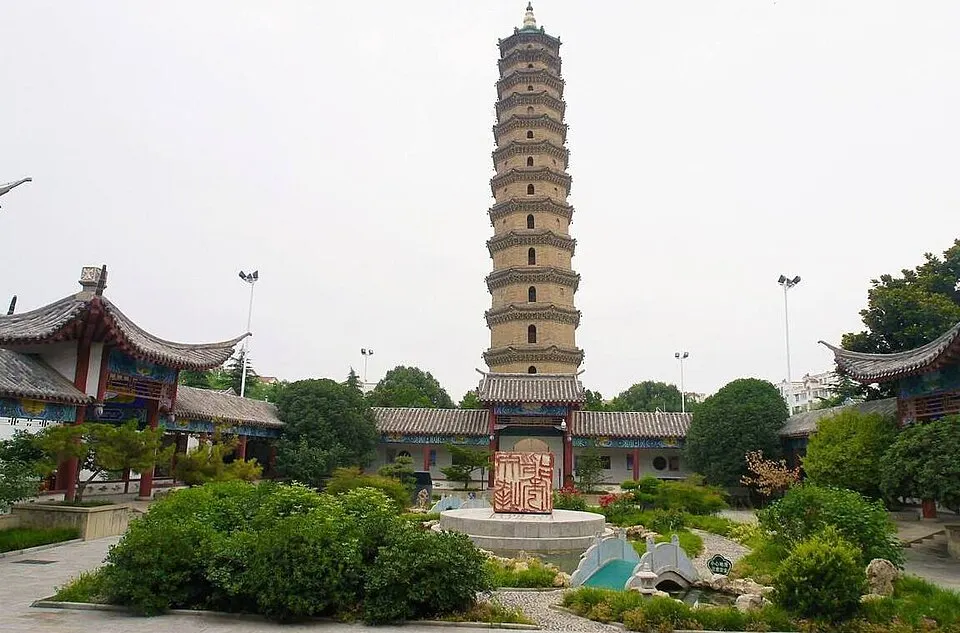
A tall octagonal brick pagoda of 13 storeys, built in 1615 on the initiative of the prefect of Xuzhou, Zheng Zhenguang, and also known as the Wenming Pagoda. - Xiangcheng Confucian Temple 襄城文庙 National heritage site
A county Confucian temple and school on Limin West Street in Xiangcheng, on this site since the Song and rebuilt many times. - Xingguo Temple Pagoda, Yanling 兴国寺塔 National heritage site · on the map
A brick pagoda, nationally listed as Song-dynasty work, standing in a village south of Yanling town as the only surviving part of Xingguo Temple. - Xudu Han–Wei City Site 汉魏许都故城 National heritage site
The site of Xu, where Cao Cao brought the last Han emperor in 196 and where the court stayed until the Wei capital moved to Luoyang in the 220s.
On the map
Open Xuchang on the illustrated map to see its outline, its places and listed sites together, and to add them to a trip.
Open Xuchang on the map