 Atlas of China
Dujiangyan Irrigation System 都江堰Dūjiāngyàn
A 2,200-year-old waterworks that tamed the Min River without a dam and still runs today
- Best time
- Apr–Oct; early April for the Qingming Water-Releasing Festival
- Time needed
- Half a day
- Days to budget
- Half a day
- Stay in
- Dujiangyan
- Region
- Sichuan
- Type
- Heritage
- Listed as
- 5A scenic area, National heritage site, UNESCO World Heritage
Why go to Dujiangyan Irrigation System
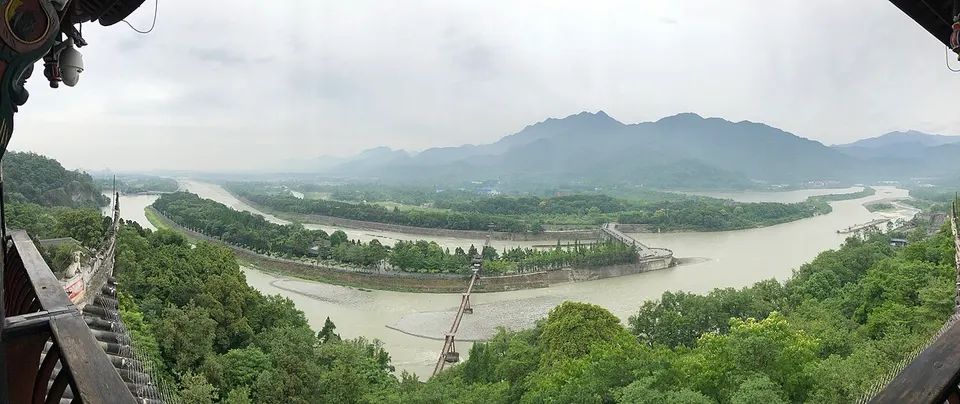
Dujiangyan is the ancient water-management scheme that turned the Chengdu Plain into the 'Land of Abundance', and it still works after more than 2,200 years. Rather than damming the Min River, it splits the flow with a fish-mouth levee, spills floodwater and silt over a low weir and feeds the plain through a channel cut through solid rock. Walk from the Bottle-Neck Channel past the Flying Sand Weir to the Fish Mouth, then cross the swaying Anlan suspension bridge to the Two Kings Temple.
The story
Li Bing, the Qin governor of Shu, began the works around 256 BC; to cut through Mount Yulei without explosives, his workers heated the rock with fire and cracked it with cold water. Legend says he also chained a troublesome river dragon in the pool below Fulong Temple, where a Han-dynasty stone statue of him, recovered from the riverbed in 1974, is now displayed.
What to see at Dujiangyan Irrigation System
- Fish Mouth 鱼嘴: The levee at the head of the system divides the Min River into inner and outer channels, with the split changing between the dry and flood seasons.
- Flying Sand Weir 飞沙堰: A low spillway that sends surplus floodwater and silt into the outer river, protecting the channel from blockage.
- Bottle-Neck Channel 宝瓶口: A gap about 20 m wide cut through the hill to feed the inner river onto the plain, with water-level marks carved into the cliff.
- Fulong Temple 伏龙观: A temple on Lidui hill, detached by the channel, honouring Li Bing, the governor traditionally credited with the scheme.
- Anlan Bridge 安澜索桥: A long rope-and-plank suspension bridge over the river, with views of the Fish Mouth.
- Two Kings Temple 二王庙: A temple on the hillside to Li Bing and his son, reached by steps up from the river.
How to visit Dujiangyan Irrigation System
The classic route begins near the Lidui side, passing Fulong Temple, the Bottle-Neck Channel, the Flying Sand Weir and the Fish Mouth before crossing Anlan Bridge to Two Kings Temple. Entering from the higher Qinyan Tower side makes the walk mostly downhill. A short route takes about two hours, and a full visit with the temples takes half a day.
How to get to Dujiangyan Irrigation System
Intercity trains from Xipu station, on Chengdu Metro Line 2, reach Lidui Park station in about 25–30 minutes, a short walk from the entrance; a few trains also run from Chengdu East. A taxi from central Chengdu takes about an hour.
Where to stay
Stay in Dujiangyan city near Nanqiao and West Street, where old lanes and evening strolls are close. A night here also makes the early start for Mount Qingcheng easier.
What to eat
- Ginkgo-nut stewed chicken 白果炖鸡: A mild chicken soup stewed with ginkgo nuts, a dish associated with the Dujiangyan and Qingcheng area.
- Qingcheng cured pork 青城老腊肉: Smoked and cured pork, sliced and stir-fried with garlic shoots or chillies.
- Brown sugar glutinous cake 红糖糍粑: Fried glutinous rice cakes served warm with brown sugar and soybean flour.
Tips for visiting Dujiangyan Irrigation System
- Book a real-name ticket online with your passport, especially for weekends and holidays, or buy one at the ticket window with it.
- Allow 3–4 hours. An electric cart covers part of the riverside walk to the Fish Mouth, but the return via the Two Kings Temple and Yulei Hill means plenty of steep steps.
- Mount Qingcheng is only about 10 km away, so the two pair naturally; stay a night in Dujiangyan to see both without rushing.
Nearby
- Mount Qingcheng 青城山 10 km
A cradle of Taoism, where forest stairways climb past temples and cave shrines - Du Fu Thatched Cottage 杜甫草堂 50 km
Bamboo groves and plum blossom where Du Fu, China's 'Poet-Sage', once lived - Kuanzhai Alley 宽窄巷子 60 km
Three restored Qing-era lanes of courtyard gateways, teahouses and Sichuan snacks - Wenshu Monastery 文殊院 60 km
An active Buddhist monastery of incense-filled courtyards, a teahouse and vegetarian food - People's Park & Heming Teahouse 人民公园与鹤鸣茶社 60 km
Bamboo chairs, jasmine tea and roving ear cleaners in Chengdu's favourite park - Wuhou Shrine & Jinli Street 武侯祠与锦里 60 km
Cypress-shaded halls honouring Three Kingdoms heroes, with a bustling snack lane next door
Also within 30 km: Guanxian Old Town, Dujiangyan 灌县古城 (under 10 km), Kuiguang Pagoda 奎光塔 (under 10 km), Lingyan Temple and Thousand Buddha Pagoda 灵岩寺 (under 10 km), Hongkou Scenic Area 虹口 (10 km), Wenchuan Earthquake Memorial Area, Yingxiu 汶川特别旅游区 (10 km), Zhanqi Village, Pidu 战旗村 (20 km).
Trips with Dujiangyan Irrigation System
- Sichuan in a week: Chengdu, Leshan, Mount Emei and Dujiangyan 7 days · Chengdu, Leshan, Emeishan and Dujiangyan
On the map
Open Dujiangyan Irrigation System on the illustrated map to see the terrain around it, what else is close, and to add it to a trip and plan the days.
Open Dujiangyan Irrigation System on the map