 Atlas of China
Yinxu 殷墟Yīnxū
The last Shang capital, where China's earliest writing and Fu Hao's tomb came to light
- Best time
- Apr–May, Sep–Oct
- Time needed
- 1 day
- Days to budget
- 1 day
- Stay in
- Anyang
- Region
- Henan
- Type
- Heritage
- Listed as
- 5A scenic area, National heritage site, UNESCO World Heritage
Why go to Yinxu
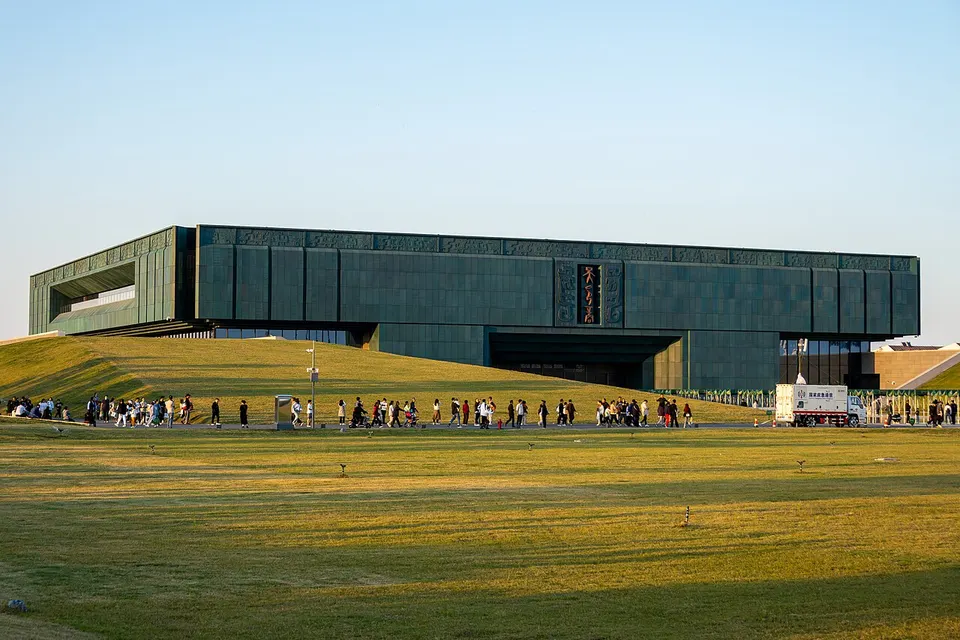
Yinxu is the ruined capital of the late Shang dynasty, spread across both banks of the Huan River on the north-western edge of Anyang. It is where the oracle-bone inscriptions, the earliest known Chinese writing, were excavated, and it was inscribed as a UNESCO World Heritage Site in 2006. Visitors walk the palace and temple area, stand at the undisturbed tomb of Fu Hao, and see the royal cemetery with its large tombs and sacrificial pits. The new Yinxu Museum, opened in 2024, shows nearly 4,000 bronzes, jades, pottery pieces and oracle bones.
The story
The site was identified after the Qing scholar Wang Yirong recognised writing on oracle bones sold as 'dragon bones' in Beijing in 1899; later scholars traced them to the village of Xiaotun, and Chinese-led excavations began in 1928. Fu Hao, a consort of King Wu Ding and a military leader, was found in 1976 in a tomb that had escaped looting, the only Shang royal-family tomb excavated intact.
What to see at Yinxu
- Yinxu Museum 殷墟博物馆: The new museum, opened in February 2024 as the core of the archaeological park, shows nearly 4,000 bronzes, jades, pottery pieces and oracle bones from the site. Start here to make sense of the ruins.
- Palace and Temple Area 殷墟宫殿宗庙遗址: The heart of the Shang capital around Xiaotun village, where excavations found the foundations of palaces and ancestral temples. Little stands above ground, but the layout shows how the royal city was organised.
- Tomb of Fu Hao 妇好墓: The tomb of a consort of King Wu Ding who also led armies, found undisturbed in 1976 and now restored for visitors. It remains the only Shang royal-family tomb found intact, and the finds from it are a highlight of the museum.
- Oracle bone pit YH127 YH127甲骨坑: The reconstructed pit where more than 17,000 inscribed oracle bones were found in 1936, in the palace-and-temple area. The inscriptions record divination questions put to the ancestors and are the earliest known Chinese writing.
- Royal Cemetery 殷墟王陵遗址: On the north bank of the Huan River, the burial ground of Shang kings, where 13 large tombs and more than 2,000 sacrificial and chariot pits have been found.
How to visit Yinxu
Start at the Yinxu Museum for the story and the objects, then walk the palace and temple area, the tomb of Fu Hao and the oracle-bone pit. The royal cemetery is on the north bank of the Huan River, a short drive from the palace area. A morning at the museum and palace area is a rewarding half day; a full day adds the royal cemetery without rushing.
How to get to Yinxu
Yinxu lies on the north-western side of Anyang, about 15–20 minutes by taxi from the city centre and roughly half an hour from Anyang East high-speed station. Anyang is on the Beijing–Guangzhou high-speed line, so it is an easy stop between Zhengzhou and Handan or Shijiazhuang.
Where to stay
Base yourself in Anyang city, which has the hotels, the station and the restaurants; the site is a short taxi ride away. Anyang is also the base for Linzhou's Taihang Grand Canyon.
What to eat
- Anyang three smoked dishes 安阳三熏: A cold-cut plate of smoked chicken, smoked eggs and smoked offal, cured over cypress and pine sawdust.
- Daokou roast chicken 道口烧鸡: A famous braised and roasted chicken from Daokou town in Hua County, in the Anyang area, tender enough to fall from the bone.
- Flat-noodle stew 扁粉菜: A big-pot Anyang everyday dish of flat starch noodles with tofu, pig's blood and seasonal vegetables in a bone broth.
Tips for visiting Yinxu
- The palace-and-temple area, the royal cemetery and the Yinxu Museum are separate parts of the visit. Book ahead in your real name on the official Yinxu WeChat account or website; passport holders who cannot use the ID-card gates have been directed to a staffed ticket window, so allow a little extra time.
- The Yinxu Museum is listed as open every day of the year apart from temporary closure notices, so there is no regular weekly closure day; check the official channels at national holidays for any daily visitor limit.
- The ruins are mostly low foundations and reconstructed outlines, so see the museum first for context. Summer is hot and shade is scarce on the open ruins.
Nearby
- Taihang Grand Canyon 太行山大峡谷 70 km
Sheer gorges in the Taihang Mountains, explored by boat, cliff path and cable car - Wanxian Mountain (Guoliang) 万仙山 80 km
A village that hand-cut a road through the cliff face
Also within 30 km: Yuanlin (Tomb of Yuan Shikai) 袁林 (under 10 km), Wenfeng Pagoda in Anyang 文峰塔 (under 10 km), Zhangde Prefecture City God Temple 彰德府城隍庙 (under 10 km), Gaoge Temple 高阁寺 (under 10 km), Han Wang Temple and Zhoujin Hall 韩王庙与昼锦堂 (under 10 km), National Museum of Chinese Writing 中国文字博物馆 (under 10 km).
On the map
Open Yinxu on the illustrated map to see the terrain around it, what else is close, and to add it to a trip and plan the days.
Open Yinxu on the map