 Atlas of China
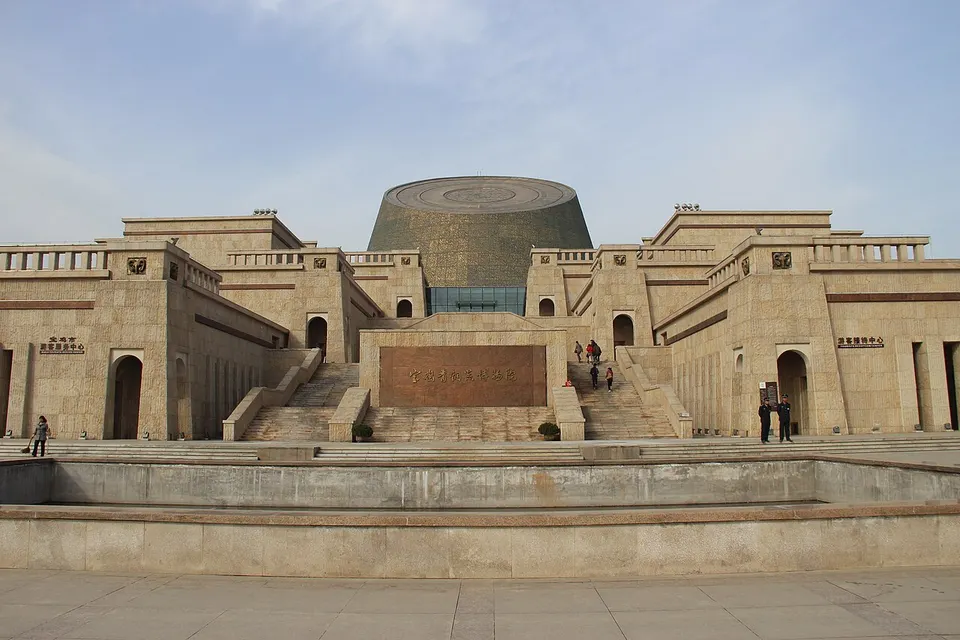
Baoji Bronze Ware Museum 宝鸡青铜器博物院Bǎojī Qīngtóngqì Bówùyuàn
Zhou dynasty bronzes, led by the He zun and the earliest known written 'Zhongguo'
- Best time
- Year-round
- Time needed
- 2–3 hours
- Days to budget
- Half a day
- Stay in
- Baoji
- Region
- Shaanxi
- Type
- Culture
- Listed as
- 4A scenic area
Why go to Baoji Bronze Ware Museum
In Baoji, on the Wei River west of Xi'an, this museum shows bronzes from a region rich in Zhou dynasty sites, where tens of thousands of bronzes have been unearthed since the Han dynasty. Head first for the He zun, an early Western Zhou ritual wine vessel displayed in a hall of its own, then look for long inscriptions such as the 372 characters of the Lai pan, which list Zhou kings, and the large bo bells of the dukes of Qin from the Spring and Autumn period.
The story
A villager dug the He zun out of the ground near Baoji in 1963 and used it to store grain; it was later sold to a scrap collector, and museum staff bought it back for 30 yuan. Only in 1975, when it was cleaned of rust for an exhibition, did a 122-character inscription appear inside the base, including the phrase 'zhai zi Zhongguo', roughly 'dwell here in the central state', the earliest known written use of Zhongguo, today the Chinese name for China.
What to see at Baoji Bronze Ware Museum
- He zun 何尊: The museum's star piece, shown in its own hall: a ritual wine vessel from the early Western Zhou with 122 characters cast inside its base.
- Lai pan 逨盘: A bronze basin whose 372-character inscription traces eight generations of one family serving twelve Zhou kings, so it reads like a short history in metal.
- King Li's gui 厉王胡簋: A grain vessel made for King Li of Zhou, one of the best-known pieces in the Zhou rites galleries, with a long inscription inside.
- Zhe gong 折觥: A Western Zhou drinking vessel shaped like an animal, picked out in the museum's guides for the quality of its casting and decoration.
- Duke of Qin bo bells 秦公镈: Large bells of the Spring and Autumn period that tell the story of Qin's rise from a Zhou border state, ending in the empire of the First Emperor.
How to visit Baoji Bronze Ware Museum
The museum stands on a slope in the Chinese Stone Drum Park, so expect a climb from the park gate. Follow the permanent display in order, from the Zhou rites to the rise of Qin, and give the He zun a few minutes on its own. Two hours covers the highlights; add time for the casting-technique displays if you like how bronzes were made.
How to get to Baoji Bronze Ware Museum
High-speed trains from Xi'an North reach Baoji South in about an hour. The museum, in the Chinese Stone Drum Park on Binhe Avenue, is about 4 km from the station, roughly 10–15 minutes by taxi.
Where to stay
Stay in Baoji city, around the railway station or along Binhe Avenue by the river, which keeps you within a short taxi ride of the museum and the trains back to Xi'an.
What to eat
- Qishan minced-meat noodles 岐山臊子面: Hand-made noodles in a sour, spicy broth topped with diced pork, the signature dish of the Baoji area.
- Rolled cold-skin noodles 宝鸡擀面皮: Chewy, springy wheat 'skin' cut into strips and dressed with chilli oil, vinegar and sesame paste; a Baoji street staple.
- Guokui flatbread 锅盔: A thick, round, crusty baked bread of the Guanzhong plain, often eaten with a stew or stuffed with fillings.
Tips for visiting Baoji Bronze Ware Museum
- The museum is closed on Mondays except public holidays.
- Book a time slot in advance through the museum's official WeChat account and bring your passport for entry.
Nearby
- Famen Temple 法门寺 70 km
A Tang relic temple, the treasures of its sealed crypt and a 148-metre modern stupa - Mount Taibai 太白山 70 km
Forest roads and a cable car climb to 3,511 metres on the Qinling range's highest peak - Qianling Mausoleum 乾陵 100 km
A spirit way of stone guardians climbing to the joint tomb of Gaozong and Wu Zetian - Maijishan Grottoes 麦积山石窟 110 km
Painted clay Buddhas in caves hung high on a haystack-shaped cliff - Louguantai 楼观台 110 km
Taoist courtyards climbing to the terrace where Laozi is said to have taught
Also within 30 km: Changleyuan Wartime Industrial Site (Shenxin Cotton Mill) 长乐塬抗战工业遗址 (under 10 km), Jintai Taoist Temple 金台观 (under 10 km), Beishouling Neolithic Site 北首岭遗址 (under 10 km), Tomb of Li Maozhen, Prince of Qin 大唐秦王陵 (under 10 km), Yongcheng Site and Tomb of Duke Jing of Qin 秦雍城遗址 (20 km), East Lake, Fengxiang 凤翔东湖 (30 km).
On the map
Open Baoji Bronze Ware Museum on the illustrated map to see the terrain around it, what else is close, and to add it to a trip and plan the days.
Open Baoji Bronze Ware Museum on the map