 Atlas of China
Xilingol 锡林郭勒Xīlínguōlè
Xanadu's ruins, a Gelug monastery and milk 'white foods' on the steppe
- Type
- League
- Region
- Inner Mongolia
- Seat
- Xilinhot
- Listed sites
- 1513 rated 4A · 4 national heritage
About Xilingol
Xilingol is a league of open steppe in central Inner Mongolia. Shangdu, known in the West as Xanadu, was Kublai Khan's summer capital, founded in 1256 and inscribed as a UNESCO World Heritage Site in 2012, and in Xilinhot, the league seat, Beizi Temple was founded in 1743 and housed about 1,500 lamas by the early 19th century. In Zhenglan Banner, herders make chagan idee, the 'white foods' of fresh milk.
What to eat in Xilingol
- Chagan idee dairy foods (察干伊德)
Listed sites in Xilingol
15 sites in Xilingol are on the official lists. Those with a page of their own link to it; the rest open as cards on the map.
- Beizi Temple (Chongshan Temple) 贝子庙 4A scenic area · National heritage site · on the map
Beizi Temple is a Gelug-school Tibetan Buddhist monastery in Chinese–Tibetan style, founded in 1743 below Erdun Aobao hill and given the name Chongshan Temple by the Qianlong emperor. - Bulin Spring, Ulagai 布林泉 4A scenic area · on the map
Bulin Spring is a grassland scenic area built around eight springs that flow all year at about 5 °C, with the remains of Bulin Temple, founded in 1672, about 1.5 km away; the temple site was conserved from 2010. - China Horse Capital Core Area 中国马都核心区 4A scenic area · on the map
A sports and culture complex of about 15 square kilometres on the southern edge of Xilinhot, developed from 2013 around Xilingol's title as China's horse capital, which the China Horse Industry Association gave the league in 2010. - Duolun Lake 多伦湖 4A scenic area · on the map
Duolun Lake is a reservoir on the upper Luan River, created by the Xishanwan hydropower scheme completed in 1999, with a surface of about 20,000 mu among hills, sand and grassland. - Erenhot National Gate Scenic Area 二连浩特国门景区 4A scenic area · on the map
The scenic area is built around the National Gate, a monumental gateway at Erenhot's port of entry on the northern edge of the city. - Erenhot National Geopark 二连浩特国家地质公园 4A scenic area · on the map
The geopark lies on the north-eastern edge of Erenhot, in the Iren Dabasu area, which is known for Cretaceous dinosaur fossils. - Imperial Horse Park, Taipusi (Yumayuan) 御马苑 4A scenic area · on the map
Yumayuan is a horse-culture and riding centre on the grassland of Taipusi Banner, with a collection of horses of more than twenty breeds, among them Akhal-Teke, Friesian, Dutch warmblood and English thoroughbred. - Mongol Khan City 蒙古汗城 4A scenic area · on the map
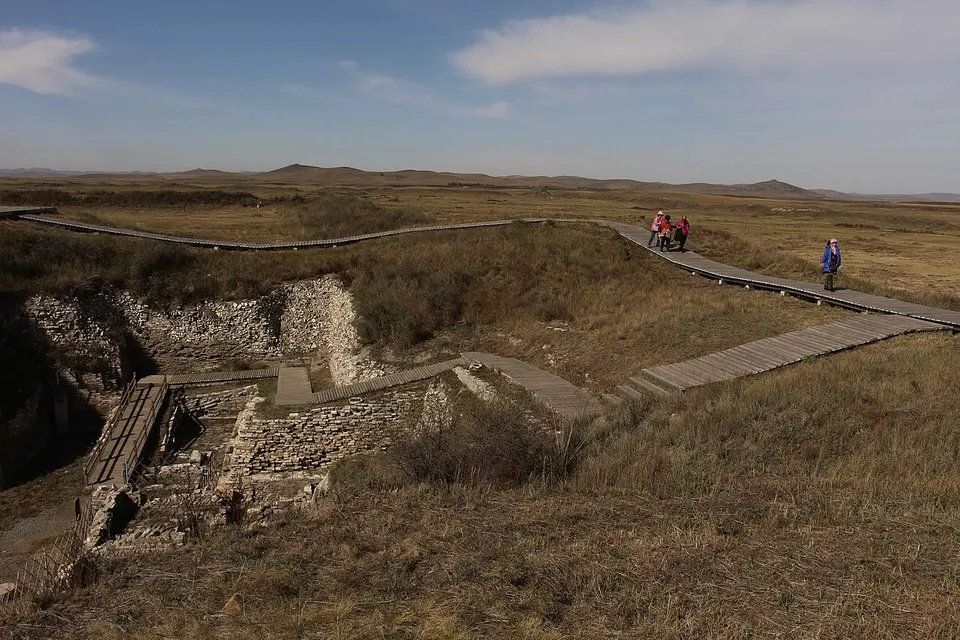
Mongol Khan City is a ger resort camp in the grassland of West Ujimqin Banner, with buildings modelled on the khan's city of Genghis Khan's enthronement and more than 150 gers for dining and overnight stays. - Shangdu (Xanadu) 元上都遗址 4A scenic area · National heritage site
Shangdu, known in the West as Xanadu, was the summer capital of Kublai Khan's Yuan dynasty, founded in 1256 beside the Luan River in the grassland north of the Great Wall, and was inscribed as a UNESCO World Heritage Site in 2012. - Starry Sky Cultural Tourism Camp 星空文化旅游营地 4A scenic area · on the map
The camp occupies 1,300 mu of grassland in Zhengxiangbai Banner, just north of the National Astronomical Observatory's Mingantu observing station. - Ulagai Jiuquwan (Nine-Bend Bay) 乌拉盖九曲湾 4A scenic area · on the map
Jiuquwan is a stretch of the Ulagai River in the far east of Xilingol where the river winds in tight loops through wetland and grassland. - Ulagai Wolf Valley 乌拉盖野狼谷 4A scenic area · on the map
Wolf Valley is a themed grassland attraction on the Hesige Ula ranch in the Ulagai Management Area, and was one of the main filming locations for the film Wolf Totem. - Wulan Wutai (Red Wutai) 乌兰五台 4A scenic area · on the map
Wulan Wutai is a scenic area of Mongolian Buddhist culture in the grassland of West Ujimqin Banner; its name means Red Wutai in Mongolian. - Huizong Temple 汇宗寺 National heritage site · on the map
Huizong Temple, called the Blue Temple in Mongolian, is a Gelug-school monastery built between 1691 and 1712 after the Kangxi emperor held an assembly of Mongol princes at Duolun Nor in 1691. - Shanxi Guild Hall, Duolun 山西会馆 National heritage site · on the map
The Shanxi Guild Hall is a Qing-period complex built from 1745 by Shanxi merchants trading in Duolun Nor, with lodgings, an entertainment area, a business meeting area and a temple to Guan Yu; about half of the original buildings remain.
On the map
Open Xilingol on the illustrated map to see its outline, its places and listed sites together, and to add them to a trip.
Open Xilingol on the map