 Atlas of China
Hebi 鹤壁Hèbì
A Shang king's capital, the Qi River of old songs and a walled canal town
About Hebi
Hebi is a coal-mining city on the edge of the Taihang foothills whose centre moved several times as new pits opened. Its older layers lie in the counties: Qi County is identified with Zhaoge, capital of the last Shang king, and the Qi River, sung in the Book of Songs, flows through it. Xun County keeps a walled Ming town on the Grand Canal, beside Dapi Mountain and its cliff-carved giant Buddha.
Listed sites in Hebi
14 sites in Hebi are on the official lists. Those with a page of their own link to it; the rest open as cards on the map.
- Adouzhai 阿斗寨 4A scenic area · on the map
A cypress-covered hill where, according to local legend, Liu Shan (A Dou), the last ruler of Shu Han and the man behind the saying 'too happy to think of Shu', was secretly held after his surrender to Wei. - Chaoyang Mountain 朝阳山 4A scenic area · on the map
A mountain area just west of Qi County town, best known for Chaoyang Temple, a 'hanging temple' built against the rock face, and an Eastern Wei cave carved with rows of small Buddha figures. - Dapi Mountain 大伾山 4A scenic area · National heritage site · on the map
A small hill on the eastern edge of Xun County town whose Tianning Temple shelters the Great Stone Buddha, a colossal seated Maitreya carved from the cliff, begun by most accounts in the Northern Qi and finished in the early Tang, inside a pavilion rebuilt in 1445. - Guling Mountain 古灵山 4A scenic area · on the map
A Taihang mountain area north-west of Qi County promoted as a setting of the Investiture of the Gods legends and a centre of the cult of the goddess Nüwa, with a Nüwa Palace temple complex, rafting on Taigong Lake, a glass suspension bridge and a cable car towards a bronze-roofed summit shrine. - Jinshan Qi River Cultural Tourism Area 金山淇河文化旅游区 4A scenic area · on the map
A riverside tourism area of about 14 km² on the Qi River in Jinshan subdistrict, Qibin district, combining the Qi River national wetland park, a Palaeogene volcanic-geology heritage park and the riverside village of Xugou, which has been developed for rural tourism with a riverbank camping ground and restaurants. - Sangyuan Town and Taiji Bend 桑园小镇·太极图 4A scenic area · on the map
A rural resort village in the Taihang hills west of Hebi, opened in 2017, with guesthouses, a forest playground, a glass walkway, an eco-trail along the Qi River and summer water rides. - Shilin Meeting Site 石林会议旧址 4A scenic area · on the map
The village where, in June 1947, Liu Bocheng and Deng Xiaoping held a military conference at Falong Temple while the headquarters of their Shanxi–Hebei–Shandong–Henan Field Army stayed here for 12 days during the Civil War. - Wuyan Mountain 五岩山 4A scenic area · on the map
A Taihang foothill in Jijiashan township, Heshan district, named for its five valleys and five rocky peaks, which tradition makes the retreat of Sun Simiao, the Tang physician revered as the King of Medicine. - Xun County Ancient Town 浚县古城 4A scenic area · National heritage site · on the map
The Ming walled town of Xun County, begun in 1370 on the Wei River section of the Grand Canal and now promoted as the Liyang City cultural tourism area. - Yunmeng Mountain 云梦山 4A scenic area · National heritage site · on the map
A Taihang mountain valley west of Qi County, also called Qingyan Mountain, where tradition places the retreat of Guiguzi, the Warring States master of strategy said to have taught Sun Bin, Pang Juan, Su Qin and Zhang Yi. - Zhaoge Culture Park 朝歌文化园 4A scenic area · on the map
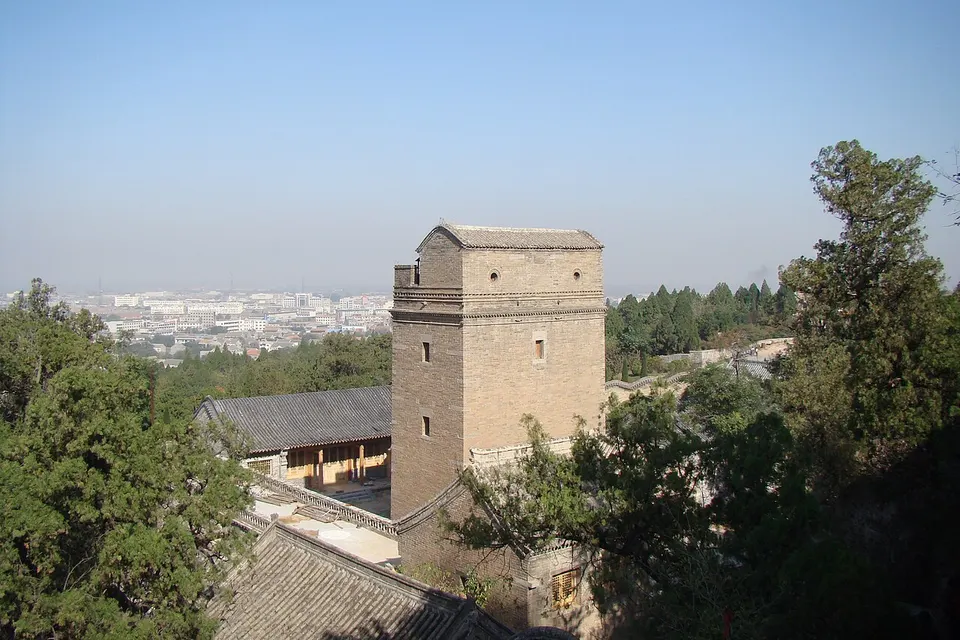
A Shang-themed cultural park on the Qi River, inspired by the Lutai site that local tradition links with the Deer Terrace where Di Xin, the last Shang king, hoarded his treasure and burned himself to death. - Bixia Palace, Xun County 碧霞宫 National heritage site
A Taoist temple complex on top of Fuqiu Hill at the south end of Xun County's old town, founded in 1542 for the goddess Bixia Yuanjun and enlarged through the Ming, Qing and Republican periods. - Wey State Capital Ruins 卫国故城 National heritage site · on the map
The rammed-earth walls of Zhaoge, capital of the Zhou state of Wey and traditionally also the last capital of the Shang, which enclosed a rectangular city around today's Qi County town until it was abandoned in the Western Han. - Xuantiandong Stone Pagoda 玄天洞石塔 National heritage site · on the map
A square, nine-storey pagoda built entirely of stone on the north bank of the Qi River near Panshitou Reservoir, first raised in the Yuan dynasty and rebuilt in 1512–1514.
On the map
Open Hebi on the illustrated map to see its outline, its places and listed sites together, and to add them to a trip.
Open Hebi on the map