 Atlas of China
Shaoguan 韶关Sháoguān
Red cliffs, a Chan patriarch's temple and the old pass road into Guangdong
About Shaoguan
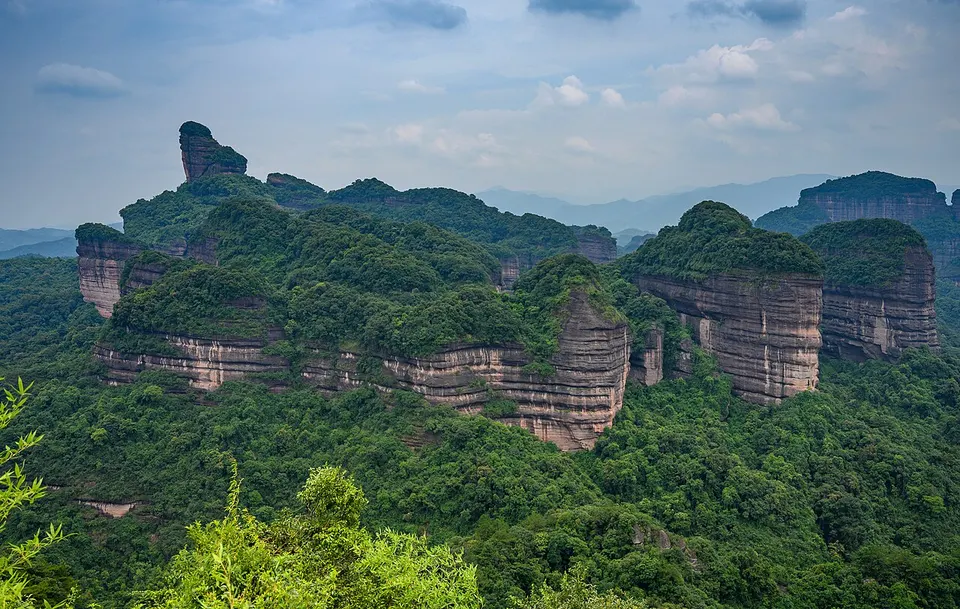
Shaoguan has long been Guangdong's northern gateway: in 716 Zhang Jiuling, later a Tang chancellor, cut the road over the Mei Pass, and many Cantonese clans trace their ancestors to Zhuji Lane below it. The red cliffs of Mount Danxia gave the Danxia landform its name, and Nanhua Temple keeps the mummified body of Huineng, the Sixth Patriarch of Chan Buddhism. Most people here are Hakka, and fortified enclosures such as Mantang Wei survive in the hills.
What to eat in Shaoguan
- Copper-ladle cakes (铜勺饼)
- Stir-fried hill-stream snails (爆炒山坑螺)
Featured places in Shaoguan
-
Mount Danxia 丹霞山
Red sandstone cliffs and flat-topped peaks that gave the 'Danxia' landform its name
Listed sites in Shaoguan
16 sites in Shaoguan are on the official lists. Those with a page of their own link to it; the rest open as cards on the map.
- Caoxi Hot Spring Holiday Resort 曹溪温泉假日度假村 4A scenic area · on the map
A hot-spring resort in Mabao town, Qujiang district, about 2 km from Nanhua Temple, the monastery of the Chan patriarch Huineng, so the two are easily combined. - Donghua Mountain and Donghua Temple 东华山 4A scenic area · on the map
A hill scenic area on the eastern edge of Wengyuan town, centred on Donghua Temple, a Chan Buddhist monastery whose main hall houses a large gilded Buddha. - Guangdong Grand Canyon 广东大峡谷 4A scenic area · on the map
A deep, forested gorge in Dabu town in the far south-west of Ruyuan county, cut through quartz sandstone by the Dabu River, which drops from the rim to the valley floor in a large waterfall. - Gufo Dongtian Cave 古佛洞天 4A scenic area · on the map
A limestone show cave on the south-western outskirts of Lechang, also called Gufo Yan ('Ancient Buddha Rock') because Buddha images were once placed inside and a temple was built at its mouth. - Jinglülun Culture Tourism Town 经律论文化旅游小镇 4A scenic area · on the map
A Chan (Zen) Buddhist-themed hot-spring resort inside Xiaokeng National Forest Park in Qujiang district, opened in 2014, with a forest hot-spring area, a hotel, a suspension bridge across a wooded valley and a jade statue of Guanyin. - Mantang Wei Hakka Enclosure 满堂围 4A scenic area · National heritage site · on the map
Begun in 1833 by the Guan family, Mantang Wei in Aizi town is a fortified Hakka communal house made up of three linked enclosures, the upper, middle and lower wei. - Mei Pass and Zhuji Lane 梅关古道·珠玑巷 4A scenic area · National heritage site
On the Meiling ridge at the Guangdong–Jiangxi border, Zhang Jiuling, later a Tang chancellor, cut a paved road through the pass in 716, opening the main overland route between the Yangtze valley and Guangzhou; the stone road and a gate tower, first built in the Song and inscribed in the Ming 'Nanyue Xiongguan' and 'First Pass of Lingnan', survive. - Yunmen Temple 云门寺 4A scenic area
Founded in 923 by the Chan master Wenyan, Yunmen Temple is the birthplace of the Yunmen school, one of the five houses of Chan (Zen) Buddhism. - Yuntianhai Forest Hot Spring Resort 云天海原始森林度假村 4A scenic area · on the map
A hot-spring resort in forested hills beside the G105 road in Xinfeng county, with spring-fed outdoor pools, a mountain-water play park and hotel accommodation. - Changwei Village Hakka Enclosure 长围村围屋 National heritage site · on the map
A four-storey Hakka fortified house in Changwei village, Luoba town, built in 1855, combining an enclosing tower block, an ancestral hall and family dwellings on a rectangular, south-facing plan. - Maba Man and Shixia Site 马坝人—石峡遗址 National heritage site
Shizi Yan, a pair of limestone hills near Maba, is where in 1958 farmers found in a cave the skull of 'Maba Man', an archaic human intermediate between Homo erectus and Homo sapiens, and where a Neolithic settlement and cemetery, the type site of the Shixia culture, was excavated from 1973. - Nanhua Temple 南华寺 National heritage site
Founded in the early 6th century as Baolin Temple, Nanhua Temple on the Caoxi stream is where Huineng, the Sixth Patriarch of Chan (Zen) Buddhism, taught from 677, making it the ancestral seat of Southern Chan. - Sanying Pagoda 三影塔 National heritage site
Completed in 1009 under the Northern Song, this hexagonal brick pagoda in central Nanxiong rises nine storeys outside, with hidden levels between them inside, and is crowned by an iron finial. - Shuangfeng Fort 双峰寨 National heritage site
A large rectangular fortified compound in Shitang village, built from 1899 over twelve years by the local gentleman Li Zisheng to shelter villagers from bandits, with a main tower and four gun towers joined by high brick walls and surrounded by a moat. - Xijing Ancient Road, Ruyuan 西京古道 National heritage site · on the map
The Xijing Ancient Road was an overland route across the mountains of northern Guangdong towards the Central Plains, first opened in the Eastern Han and kept in use until the Qing. - Yunlong Temple Pagoda 云龙寺塔 National heritage site · on the map
A square, five-storey solid brick pagoda with a platform at each level, built in the late Tang dynasty between 894 and 901 and repaired in the Ming.
On the map
Open Shaoguan on the illustrated map to see its outline, its places and listed sites together, and to add them to a trip.
Open Shaoguan on the map