 Atlas of China
Tianshui 天水Tiānshuǐ
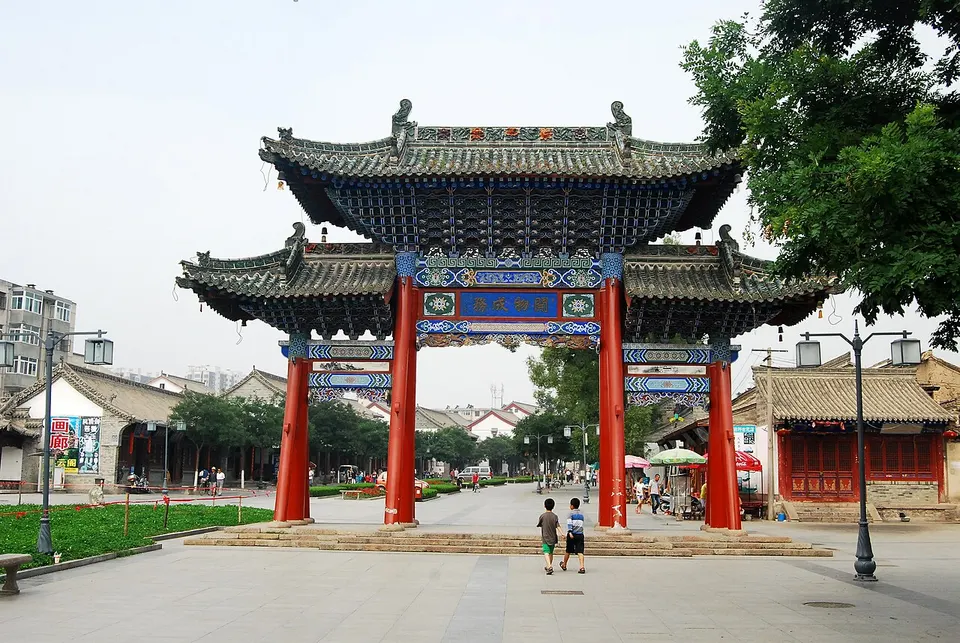
A haystack crag of Buddhist caves and the temple of the legendary Fuxi
About Tianshui
Tianshui, one of Gansu's largest cities, lies in the green upper valley of the Wei River and is known as the hometown of Fuxi, the legendary forefather of Chinese civilisation, whose Ming temple stands in the old town. South-east of the city, some 200 caves of painted clay sculpture honeycomb the red crag of Maijishan, part of the Silk Roads World Heritage Site. Farther afield are the Neolithic house floors of the Dadiwan Site in Qin'an and the giant cliff Buddhas of Shuiliandong and Daxiangshan.
What to eat in Tianshui
- Tianshui guagua (天水呱呱)
Featured places in Tianshui
-
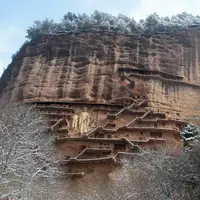
Maijishan Grottoes 麦积山石窟
Painted clay Buddhas in caves hung high on a haystack-shaped cliff
Listed sites in Tianshui
20 sites in Tianshui are on the official lists. Those with a page of their own link to it; the rest open as cards on the map.
- Daxiangshan (Big Buddha Mountain) 大像山 4A scenic area · on the map
A hillside of temples and grottoes on Wenqi Mountain just west of Gangu town, named after the large Buddha carved into the cliff near its summit. - Fengshan Hill, Qin'an 凤山 4A scenic area · on the map
A hill on the eastern edge of Qin'an town covered by the Taishan Temple complex, 41 Ming and Qing halls, pavilions and cave shrines built on nine terraces, with Confucian, Buddhist and Taoist figures side by side. - Fuxi Temple, Tianshui 伏羲庙 4A scenic area · National heritage site
A Ming-dynasty temple to Fuxi, the legendary forefather of Chinese civilisation, laid out as a series of courtyards along one axis on Fuxi Road in the old part of Tianshui. - Gupo Grassland 古坡草原 4A scenic area · on the map
Upland meadows, forest and rocky peaks around the headwaters of the Ji River in southern Gangu County, between about 1,760 and 2,700 m above sea level. - Nanguo Temple (Nanshan Scenic Area) 南郭寺 4A scenic area
A Buddhist temple in a fold of the hills about 2 km south of central Tianshui, already a sizeable monastery in the Tang dynasty and visited by the poet Du Fu in 759, who wrote verses about it. - Ping'an Grassland 平安草原 4A scenic area · on the map
An expanse of high mountain meadows, valleys and streams in the Guan Mountains of Zhangjiachuan Hui Autonomous County, where the early Qin state is said to have pastured its horses. - Qingjuanshan Resort 青鹃山 4A scenic area · on the map
A countryside resort around Sunji village in Pingnan town, south of Tianshui, laid out around a lake lined with themed wooden cabins where visitors can fish, go boating and cook their catch in the cabins' kitchens. - Shuiliandong Grottoes and Lashao Temple 水帘洞石窟 4A scenic area · National heritage site · on the map
A group of cave temples in a narrow gorge north-east of Wushan town, named after a natural cave about 50 m high whose overhang turns into a curtain of water when it rains. - Suwan Folk Manor 苏湾民俗庄园 4A scenic area · on the map
A rural folk-culture park in Sujiawan village, Pingnan town, in the hills south of Tianshui, which became a 4A scenic area in 2025. - Yuquan Taoist Temple 玉泉观 4A scenic area · National heritage site
A Taoist temple complex climbing the foot of Tianjing Mountain on the north side of Tianshui's old city, founded in the Tang dynasty and rebuilt by Quanzhen Taoists from the Yuan onwards. - Dadiwan Site 大地湾遗址 National heritage site · on the map
One of the key Neolithic sites of the Yellow River basin, occupied from about 7,800 to 4,800 years ago, where excavations from 1978 uncovered more than 700 features, among them house foundations, hearths, kilns and graves, and nearly ten thousand artefacts. - Heyu Cliff Inscription 河峪摩崖石刻 National heritage site · on the map
An Eastern Han inscription carved into a rock face at Heyu in eastern Zhangjiachuan County, listed as a national heritage site in 2019. - Houjie Mosque 后街清真寺 National heritage site · on the map
A working mosque of Tianshui's Hui community in Qinzhou District, whose buildings date from the Ming and Qing dynasties. - Hu Family Residences (Tianshui Folk Museum) 胡氏古民居 National heritage site · on the map
Two Ming-dynasty courtyard mansions facing each other across a street in Tianshui's old city, built in the Jiajing era (1522–1566) by the scholar Hu Laijin and lived in by his descendants for generations. - Ji Xin Temple, Tianshui 纪信祠 National heritage site
Tianshui's City God temple, dedicated to Ji Xin, a general of the founder of the Han dynasty who is worshipped as the city god in Tianshui and Lanzhou. - Majiayuan Site and Chariot Museum 马家塬遗址 National heritage site · on the map
Majiayuan, in the hills north of Zhangjiachuan town, is a Warring States cemetery of Western Rong chieftains, a people drawn into the state of Qin, whose tombs held richly decorated chariots and gold and silver ornaments in a style linked to the steppe cultures further west. - Mutisi Grottoes 木梯寺石窟 National heritage site · on the map
A cave temple high on the slopes of Bailin Mountain in Mali town, west of Wushan, named, legend says, after a wooden ladder that was once the only way up the cliff to it. - Qin'an Confucian Temple 秦安文庙 National heritage site · on the map
Qin'an's Confucian temple, founded before 1297, keeps a Ming-dynasty Dacheng Hall under a single-eaved hip-and-gable roof of glazed tiles, one of the better-preserved Ming timber buildings in Gansu. - Shengshou Temple, Wushan 武山圣寿寺 National heritage site · on the map
A temple in Wushan County whose surviving buildings date from the Yuan dynasty to the Republican era, listed as a national heritage site in 2019. - Xingguo Temple, Qin'an 兴国寺 National heritage site · on the map
A Yuan-dynasty Buddhist temple in the centre of Qin'an town whose main building, the Prajna Hall, is dated by an inscribed board of the Zhishun era (1330–1333) found inside its wall in 1974.
On the map
Open Tianshui on the illustrated map to see its outline, its places and listed sites together, and to add them to a trip.
Open Tianshui on the map