 Atlas of China
Mount Wutai 五台山Wǔtái Shān
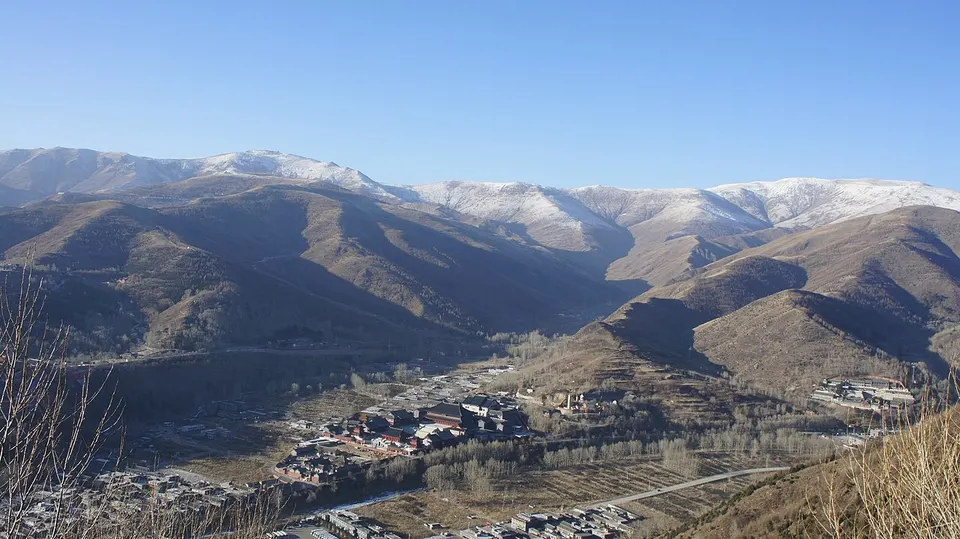
Temples, a towering white stupa and yellow-tiled roofs below five flat-topped holy peaks
- Best time
- Jun–Sep; roads to the terraces often close Nov–Apr
- Time needed
- 1 day
- Days to budget
- 1 day
- Stay in
- Taihuai
- Region
- Shanxi
- Type
- Heritage
- Listed as
- 5A scenic area, National heritage site, UNESCO World Heritage
Why go to Mount Wutai
Mount Wutai in north-east Shanxi is one of China's four sacred Buddhist mountains, a high massif whose five flat-topped peaks, the 'five terraces', are identified with Manjushri, the bodhisattva of wisdom. Dozens of Han Chinese and Tibetan Buddhist monasteries cluster around the valley town of Taihuai: walk from Xiantong Temple to the great White Stupa of Tayuan Temple, then climb to yellow-roofed Pusading. With a second day, ride a tourist minibus up to the bare, grassy terraces themselves.
The story
Qing emperors made repeated pilgrimages to Mount Wutai, partly to strengthen ties with the Mongols, for whom the mountain was also holy. Pusading, roofed in the yellow glazed tiles reserved for imperial buildings, was handed to Tibetan Buddhist lamas in the early 18th century, and Han Chinese and Tibetan monasteries still stand side by side.
What to see at Mount Wutai
- Xiantong Temple 显通寺: This monastery in the valley centre has a brick Wuliang Hall built without beams, and a Bronze Hall whose walls are covered in thousands of tiny Buddha figures.
- Tayuan Temple and the White Stupa 塔院寺·大白塔: The great white stupa is the symbol of Mount Wutai, hung with some two hundred copper bells that ring in the wind. A smaller stupa beside it is said to hold a lock of Manjushri's golden hair.
- Pusading 菩萨顶: This Tibetan Buddhist monastery holds two stone stelae inscribed in Kangxi's own hand in Chinese, Mongolian, Manchu and Tibetan, a reminder of the imperial visits.
- Nanshan Temple 南山寺: Built in tiers up the hillside, the temple is known for its stone and clay carvings, which mix Buddhist stories with Daoist tales and plant motifs. From the top level you can look out toward the other terraces.
How to visit Mount Wutai
Taihuai's main temples lie close together in the valley, so a half-day on foot can cover Xiantong, Tayuan and Pusading, with Dailuoding added by the stone steps or the cable car. A full day adds Nanshan Temple and a slower look at the Tibetan Buddhist side of the mountain; the five terraces themselves need separate transport and are often shut by snow in winter. Foguang and Nanchan temples lie outside the central area and are covered separately.
How to get to Mount Wutai
Long-distance buses from Taiyuan East Bus Station reach Taihuai in about 3.5–4 hours, and there are also buses from Datong (about 4 hours) and from Xinzhou, near Xinzhou West high-speed station. Slow trains from Beijing and Taiyuan stop at Wutaishan station in Shahe, about 1.5 hours from Taihuai by bus or car.
Where to stay
Stay in Taihuai, the valley town at the heart of the temple cluster, so that you can walk to the monasteries early and late; the terraces are reached from there by road.
What to eat
- Taimo mushroom stewed with chicken 台蘑炖鸡: Wild mushrooms from the cold high meadows, dried, soaked and slow-cooked with local chicken in a clay pot; the soaking water goes back in for extra flavour.
- Tofu balls 豆腐丸子: Local spring-water tofu is crumbled, seasoned with pepper and ginger, shaped, steamed and fried to a golden shell, then eaten dry with pepper salt or simmered in broth.
- Iron-pot stew 铁锅烩菜: A big communal pot of tofu balls, meatballs, braised pork, potato, vermicelli, mushrooms and daylily in bone broth, a home-style dish served in most of the town's restaurants.
Tips for visiting Mount Wutai
- Pack warm layers: Taihuai lies at about 1,700 metres and the North Terrace reaches 3,061 metres, so nights are cold even in summer.
- Climb the 1,080 steps (or take the cable car) to Dailuoding, whose hall of five Manjushri statues, one for each terrace, lets pilgrims make a 'small pilgrimage' to all five at once.
- Bring your passport: tickets are real-name, and foreign visitors may find it easier to buy at the visitor-centre windows than through the online booking system, which is built around Chinese ID cards.
Nearby
- Foguang Temple 佛光寺 20 km
A Tang timber hall of 857 on a quiet hillside, still filled with its Tang clay statues - Yanmen Pass 雁门关 70 km
A Ming fortress gate on the Inner Great Wall, its ramparts running up the mountain ridges - Yingxian Wooden Pagoda 应县木塔 70 km
A Liao-dynasty timber pagoda of 1056, five storeys outside and nine within - Hanging Temple 悬空寺 70 km
A wooden temple pinned to a sheer cliff, seemingly propped up on stilts
Also within 30 km: Luohou Temple 罗睺寺 (under 10 km), Nanshan Temple, Mount Wutai 南山寺 (under 10 km), Fanshi Glazed Pagoda 繁峙琉璃塔 (under 10 km), Shanxi-Chahar-Hebei Military Region Headquarters Site, Jingangku 金岗库村晋察冀军区司令部旧址 (10 km), Mimi Temple 秘密寺 (20 km), Gongzhu Temple 公主寺 (20 km).
On the map
Open Mount Wutai on the illustrated map to see the terrain around it, what else is close, and to add it to a trip and plan the days.
Open Mount Wutai on the map