 Atlas of China
Lama Temple 雍和宫Yōnghégōng
Incense-filled courtyards and an 18-metre sandalwood Buddha in a working monastery
- Best time
- Apr–May, Sep–Oct; very crowded around Chinese New Year
- Time needed
- 1–2 hours
- Days to budget
- Half a day
- Stay in
- Beijing
- Region
- Beijing
- Type
- Heritage
- Listed as
- National heritage site
Why go to Lama Temple
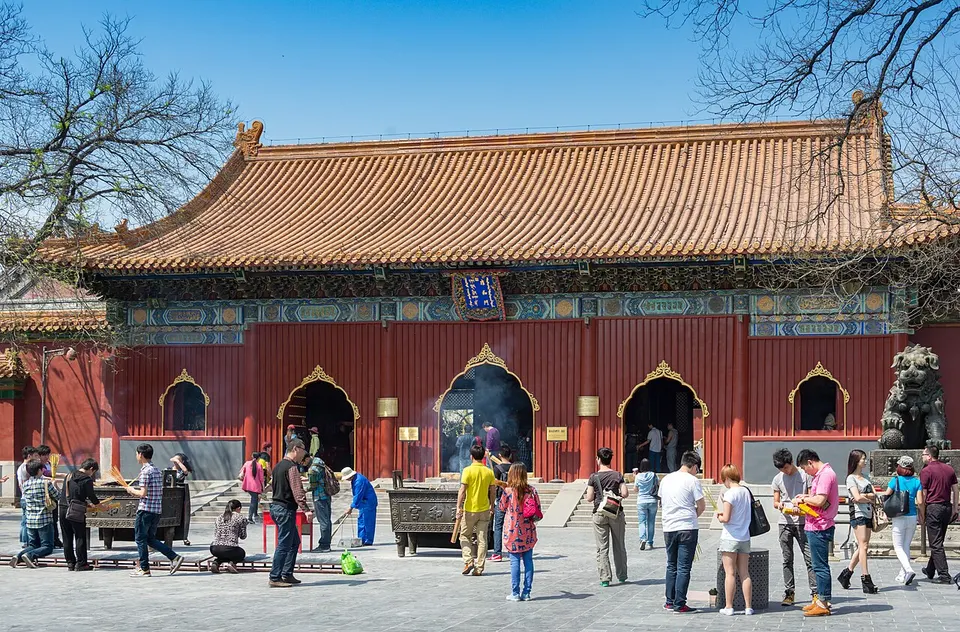
In the north-east of the old city, the Lama Temple is a working monastery of the Gelug school of Tibetan Buddhism, built in a mix of Han Chinese and Tibetan styles. It began as the home of Prince Yong, the future Yongzheng Emperor, and was turned into a lamasery, a monastery for Tibetan Buddhist monks, in 1744. Walk north through its courtyards and five main halls to the last of them, the Pavilion of Ten Thousand Happinesses.
The story
The Maitreya Buddha in that pavilion stands about 18 metres high, with a further 8 metres said to be buried below ground, and was carved from a single piece of white sandalwood from Nepal, a gift from the seventh Dalai Lama to the Qianlong Emperor. Guinness World Records lists it as the tallest statue carved from a single piece of wood.
What to see at Lama Temple
- Memorial Archways and Zhaotai Gate 牌楼和昭泰门: Three carved archways and a broad imperial carriage path lead up to the temple's glazed-tile main gate, a reminder that this was once a prince's palace. Inside, stele pavilions, a drum tower and a bell tower flank the first courtyard.
- Hall of Harmony and Peace 雍和宫殿: The main hall, once the prince's audience hall, holds three bronze Buddhas of the Past, Present and Future, with eighteen arhats along the side walls.
- Hall of Everlasting Protection 永佑殿: Once Prince Yong's living quarters, and later where the Yongzheng Emperor's coffin rested after his death, it now enshrines the Medicine Buddha.
- Hall of the Wheel of the Law 法轮殿: The monastery's main teaching hall, topped with five Tibetan-style skylights. It houses a statue of Tsongkhapa, founder of the Gelug school, and a carved Five-Hundred-Arhat Hill.
- Pavilion of Ten Thousand Happinesses 万福阁: The last of the great halls is three storeys high and joined to two side pavilions by covered bridges. It shelters the giant sandalwood Maitreya.
How to visit Lama Temple
Enter from the south and walk the 480-metre central axis north, hall by hall, finishing at the Pavilion of Ten Thousand Happinesses; allow an hour or so for the main route. Side courtyards hold smaller halls and the temple's Tibetan Buddhist art museum, which adds time if you want more than a first look. It is a working monastery, so keep your voice down inside the halls and follow any no-photography signs.
How to get to Lama Temple
Metro Lines 2 and 5 both stop at Yonghegong Lama Temple station, a short walk from the temple; a taxi from Tian'anmen takes about 20 minutes, depending on traffic.
Where to stay
The hutongs around Nanluoguxiang, Gulou and the Guozijian area keep you within walking distance of the temple and the old lanes. The Dongzhimen area to the east is handy for the metro and Ghost Street.
What to eat
- Spicy crayfish (málà xiǎolóngxiā) 麻辣小龙虾: Ghost Street (Guijie), the long restaurant row on Dongzhimen Nei Street a short way south-east, is known for its late-night spicy crayfish.
- Scalded tripe (bàodǔ) 爆肚: A classic Beijing snack of quickly scalded tripe served with a sesame-paste dipping sauce, found in snack shops around the hutongs near the temple.
Tips for visiting Lama Temple
- Buy tickets through the temple's official WeChat account: passport holders can book online and scan the QR code at the gate, and the temple says it has not authorised any other sellers.
- Incense is handed out at the entrance, and you may not bring your own.
- There is no luggage storage, so travel light; the Temple of Confucius is a short walk west along Guozijian Street.
Nearby
- Temple of Confucius and Imperial Academy 孔庙和国子监 under 10 km
Courtyards of stone steles naming imperial exam graduates, beside the old Imperial Academy - Drum and Bell Towers 钟鼓楼 under 10 km
Beijing's old timekeeping towers, with drum performances and views over the hutong roofs - Shichahai 什刹海 under 10 km
Three linked lakes ringed by hutongs and lakeside bars, with open-air skating in winter - Prince Gong's Mansion 恭王府 under 10 km
A Qing courtyard mansion and rock garden, home first to a corrupt minister, then a prince - Beihai Park 北海公园 under 10 km
A former imperial lake garden crowned by a white Tibetan-style stupa on its island - Forbidden City 故宫 under 10 km
Six centuries of imperial power behind vermilion walls in the heart of Beijing
Also within 30 km: Bailin Temple 柏林寺 (under 10 km), Temple of Earth 地坛 (under 10 km), Wen Tianxiang Temple 文天祥祠 (under 10 km), Zhizhu Temple 智珠寺 (under 10 km), Red Building of Peking University 北京大学红楼 (under 10 km), Guo Moruo Residence 郭沫若故居 (under 10 km).
On the map
Open Lama Temple on the illustrated map to see the terrain around it, what else is close, and to add it to a trip and plan the days.
Open Lama Temple on the map