 Atlas of China
Jokhang Temple & Barkhor 大昭寺与八廓街Dàzhāo Sì Yǔ Bākuò Jiē
Tibet's holiest temple, ringed by the pilgrim circuit of the Barkhor
- Best time
- Apr–Oct
- Time needed
- 2–3 hours
- Days to budget
- Half a day
- Stay in
- Lhasa
- Region
- Tibet
- Type
- Culture
- Listed as
- 5A scenic area, National heritage site, UNESCO World Heritage
Why go to Jokhang Temple & Barkhor
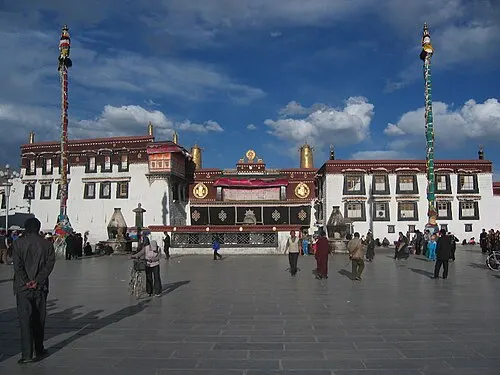
The Jokhang is regarded as the most sacred temple in Tibet, founded in the mid-7th century under King Songtsen Gampo and enlarged many times since. Its main chapel houses the Jowo Shakyamuni, a statue of the Buddha said to have been brought by Princess Wencheng, and the gilded roofs look out over Barkhor Square at the heart of Lhasa's old town. Pilgrims circle it day and night on the inner Nangkor and the outer Barkhor kora, which makes the streets around it the best place in Lhasa to watch living faith.
The story
Tibetans say that Lhasa grew up around the temple rather than the other way round. Legend has it that the king tossed a ring or hat to choose the site, and the temple was built over a lake that was then filled in and its design and carving are credited to Nepalese craftsmen. It joined the Potala Palace's World Heritage listing as an extension in 2000.
What to see at Jokhang Temple & Barkhor
- Barkhor Square 八廓广场: The open square in front of the temple, with incense burners where pilgrims offer juniper smoke and long lines of worshippers prostrating on the flagstones.
- Entrance courtyard and Nangkor 囊廓: Inside the main gate a courtyard leads to a covered inner circuit lined with prayer wheels, which pilgrims spin as they walk the temple's own kora.
- Jowo Shakyamuni chapel 觉沃佛殿: The innermost shrine holds the gilded statue of the Buddha as a twelve-year-old prince, adorned with jewels, the most revered image in Tibet; pilgrims queue to touch their foreheads to the platform.
- Chapels and roof terrace 殿堂与金顶: Dozens of dim, butter-lamp-lit chapels surround the main hall, including one with figures of Songtsen Gampo and his queens. Upstairs the roof is crowned with a golden wheel flanked by deer and gives views across to the Potala.
- Barkhor Street 八廓街: The roughly one-kilometre ring road around the temple, taking about 20 minutes to walk, packed with stalls selling prayer flags, butter lamps, silver and thangkas among the whitewashed old houses.
How to visit Jokhang Temple & Barkhor
Enter through the main gate on the west side, follow the one-way flow of pilgrims clockwise through the courtyard and chapels, then climb to the roof for the view before leaving. Allow about two hours inside, more if you linger with the worshippers. Finish by walking the Barkhor kora, ideally early in the morning or at dusk when local pilgrims are out in force; a half-day covers both comfortably.
How to get to Jokhang Temple & Barkhor
The temple stands in the old town about 1.5 km east of the Potala Palace and is walkable from most central Lhasa hotels. Lhasa itself is reached by air from major Chinese cities or on the Qinghai–Tibet Railway.
Where to stay
Stay in the Barkhor old town or just beyond it, where traditional guesthouses put the temple, tea houses and the Potala within walking distance. Lhasa's newer districts to the west offer more modern hotels a short taxi ride away.
What to eat
- Yak butter tea 酥油茶: Hot tea churned with yak butter and salt, served everywhere on the plateau and more of a warming broth than a tea.
- Tibetan sweet tea 甜茶: Milky, sugared black tea served in the city's tea houses, the usual companion to a bowl of noodle soup.
- Thukpa 土巴: A hearty Tibetan noodle soup, often with yak meat, found on breakfast menus and in tea houses.
Tips for visiting Jokhang Temple & Barkhor
- Foreign visitors need a Tibet Travel Permit arranged through a licensed agency; entry to the temple is by real-name booking made in advance through the temple's mini-program, which your agency handles, and visits can be suspended during major religious events.
- Walk clockwise like the pilgrims, dress modestly with shoulders and knees covered, and ask before photographing monks or worshippers.
- Lhasa sits at about 3,650 m, so give yourself a day or two to acclimatise and go slowly on the temple's steep stairs.
Nearby
- Potala Palace 布达拉宫 under 10 km
The red and white palace of the Dalai Lamas, rising in tiers above Lhasa - Yamdrok Lake 羊卓雍措 70 km
A turquoise, snow-ringed sacred lake revealed from the Kamba La pass
Also within 30 km: Tromzikhang (Qing Ambans' Office Museum) 冲赛康 (under 10 km), Ramoche Temple 小昭寺 (under 10 km), Drak Lhalupuk Cave Temple 查拉鲁普石窟 (under 10 km), Lhasa Nanshan Park 南山公园 (under 10 km), Tibet Museum 西藏博物馆 (under 10 km), Princess Wencheng Tibetan Culture Park 文成公主藏文化风情园 (under 10 km).
On the map
Open Jokhang Temple & Barkhor on the illustrated map to see the terrain around it, what else is close, and to add it to a trip and plan the days.
Open Jokhang Temple & Barkhor on the map