 Atlas of China
Quzhou 衢州Qúzhōu
Confucius's southern heirs, Danxia peaks and spicy rabbit heads
About Quzhou
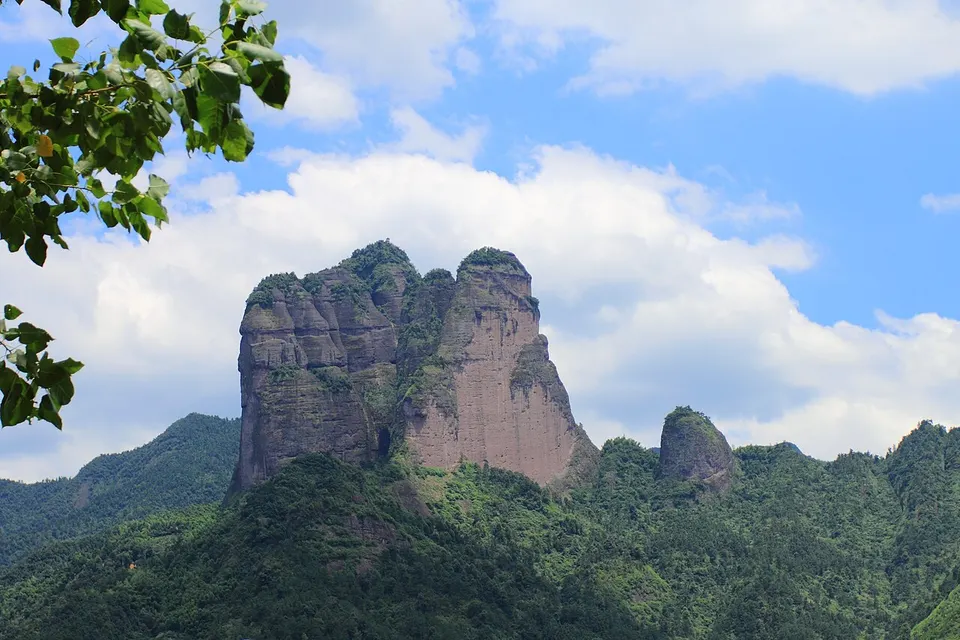
Quzhou sits on the western edge of Zhejiang, bordering Anhui, Jiangxi and Fujian; an old saying calls it the crossroads of four provinces. When the Song court fled south in the 12th century, the senior line of Confucius's descendants settled here, and their Temple of Southern Confucianism is one of only two Kong family temples in China. Out of town are the sheer peaks of Mount Jianglang, a World Heritage site, the old border town of Nianbadu and the man-made Longyou Caves, of unknown date.
What to eat in Quzhou
- Spicy rabbit heads (兔头)
- Longyou fagao cake (龙游发糕)
Listed sites in Quzhou
27 sites in Quzhou are on the official lists. Those with a page of their own link to it; the rest open as cards on the map.
- Mount Jianglang & Nianbadu 江郎山·廿八都 5A scenic area
Mount Jianglang is a row of three sheer red-rock pillars, Langfeng, Yafeng and Lingfeng, each more than 300 m tall, with the summit of Langfeng at 816.8 m; it is part of the China Danxia World Heritage Site, and paths climb between the peaks, including the narrow 'strip of sky' passage between Yafeng and Lingfeng, only 3.5 m wide at its narrowest. - Root Palace Buddhist Cultural Tourism Zone 根宫佛国 5A scenic area · on the map
A cultural park on the edge of Kaihua county town created by the root-carving artist Xu Guqing, where garden courtyards and buildings display thousands of root carvings and bonsai made from tree roots, a craft practised in Kaihua since the Tang dynasty. - Dachen Ancient Village 大陈古村 4A scenic area · on the map
A village with a history of more than 600 years in Dachen township, Jiangshan, its houses, mostly from the Qing dynasty, built close against the surrounding hills. - Gutianshan National Nature Reserve 古田山 4A scenic area · on the map
A national nature reserve of about 81 km² in the mountains of western Kaihua on the Jiangxi border, set up in 1975 and upgraded in 2001 to protect subtropical evergreen broadleaf forest. - Longyou Caves 龙游石窟 4A scenic area · National heritage site
A group of 24 huge man-made caverns cut into the sandstone of Fenghuang Hill beside the Qu River, found in 1992 when farmers drained five village ponds and discovered that they were flooded caverns. - Longyou Folk Residence Garden 龙游民居苑 4A scenic area · National heritage site
An open-air museum of old architecture on Jiming Hill on the southern edge of Longyou town, where Ming and Qing buildings from around the county that could not be protected where they stood have been dismantled and rebuilt since 1991. - Longyou Rosewood Town 龙天红木小镇 4A scenic area · on the map
A modern 'characteristic town' of about 3.5 km² in Huzhen, Longyou, built around the rosewood (hongmu) furniture industry, with traditional-style buildings, furniture workshops, a timber trading area and a rosewood cultural and creative park. - Meishudi Scenic Area 梅树底 4A scenic area · on the map
A forested hill scenic area of about 8 km² in eastern Changshan, known for its old trees, wide bamboo forests and the Jiulong Waterfall, which drops down a sheer cliff. - Mount Fugai 浮盖山 4A scenic area · on the map
A forested mountain on the Zhejiang–Fujian border just south of Nianbadu, an outlier of the Xianxia range whose 1,146 m summit lies on the Fujian side. - Qicai Changhong Scenic Area 七彩长虹 4A scenic area · on the map
A rural scenic area covering Changhong township in the forested north-west of Kaihua, on the Jiangxi border next to Wuyuan, with woodland over more than 85% of its land. - Quzhou Ancient City & City Walls 衢州古城 4A scenic area · National heritage site
The historic core of Quzhou, a 3.2 km² cultural tourism zone opened in 2016 around Shuiting Gate, where the Ming–Qing city wall stands beside the Qu River, and the 'three streets and seven alleys' of old lanes lined with restored buildings, craft workshops and food stalls. - Sanqu Stone Forest 三衢石林 4A scenic area · on the map
A karst landscape on Sanqu Mountain in Huibu town, Changshan, where limestone formed from a reef about 440 million years ago (late Ordovician) has weathered into clusters of rock pinnacles, mazes, arches and fissures. - Taoyuan Qili Scenic Area 桃源七里 4A scenic area · on the map
A large mountain and rural scenic area of about 60 km² in Qili township, Kecheng, at an average altitude of 650 m and almost entirely forested. - Xianxia Pass 仙霞关 4A scenic area · on the map
A fortified pass on the ancient Xianxia road over the Xianxia range, for centuries an important overland route between the Qiantang and Min river basins of Zhejiang and Fujian. - Yaowang Mountain 药王山 4A scenic area · on the map
A forested mountain scenic area in southern Qujiang, part of the Ziweishan National Forest Park, promoted for its clean air and themed on traditional Chinese medicine, from which it takes its name ('Medicine King Mountain'). - Guanxi Shijia Ancestral Hall 关西世家 National heritage site · on the map
A Ming ancestral hall of the Wanli era (1573–1620) in Yangjia village in the north of Longyou, two courtyards deep with a stage. - Huzhen Sarira Pagoda 湖镇舍利塔 National heritage site · on the map
A six-sided, seven-storey brick pagoda about 27 m tall, built solid in imitation of a timber tower, on Xiajie street in Huzhen town. - Lan Clan Ancestral Hall, Beier 北二蓝氏宗祠 National heritage site · on the map
The ancestral hall of the Lan clan, a family of the She ethnic minority, in Beier village, Hangbu town, built in 1628 at the end of the Ming dynasty. - Sanhuai Hall, Rudamen 三槐堂 National heritage site · on the map
The ancestral hall of the Wang clan in Rudamen, part of Tianchi village in Hengshan town, a Ming–Qing building five courtyards deep with a stage and side rooms, covering about 1,500 m². - Sanmenyuan Ye Family Residences 三门源叶氏民居 National heritage site · on the map
Three surviving mansions of the Ye family in Sanmenyuan village, Shifo township, built in 1846 against Hushan hill above a stream, with courtyards, a garden and a pond. - Sanqingkou Porcelain Workshops 三卿口制瓷作坊 National heritage site
A porcelain-making village in a small valley in Xiakou town, where the Huang family set up kilns in the Qianlong era of the Qing dynasty, using local kaolin, water-powered pounding mills and wood from the hills, and shipped blue-and-white wares along the Xianxia road. - Shaoyi Hall & Hengshan Pagoda 绍衣堂和横山塔 National heritage site · on the map
Two Ming monuments in Hengshan town in northern Longyou, listed together. - Temple of Southern Confucianism 孔氏南宗家庙 National heritage site
The family temple of the southern branch of Confucius's descendants, who followed the Song court south after the fall of Kaifeng in 1127 and were given a home in Quzhou; the temple has stood on its present site since 1520 and took its current form in a rebuilding of 1821–23. - Wenchang Palace, Nianbadu 廿八都文昌宫 National heritage site · on the map
A temple to Wenchang, the god of literature, in Xunli, the core of Nianbadu old town, built in 1909–1911 with three courtyards and a three-storey main hall under a double-eaved roof with painted ceilings. - Wu Ancestral Hall, Chetang 车塘吴氏宗祠 National heritage site · on the map
A Ming-dynasty ancestral hall of the Wu clan in Chetang village, Yunxi township, built in the Jiajing reign in the early 1530s. - Xianyan Cave Inscriptions 仙岩洞摩崖题记 National heritage site
A red-sandstone cave with a mouth about 25 m wide and a depth of about 22 m, south of Hongxing village in Zhangtan, whose walls carry more than 50 carved inscriptions left by officials and scholars from the late 8th to the late 19th century, most of them from the Southern Song. - Yang Ancestral Halls, Nanwu 南坞杨氏宗祠 National heritage site · on the map
Two ancestral halls of the Yang clan in Nanwu village, Fenglin town: the inner hall in the village centre dates from the late Ming or early Qing, and the slightly later outer hall at the village entrance adds side wings.
On the map
Open Quzhou on the illustrated map to see its outline, its places and listed sites together, and to add them to a trip.
Open Quzhou on the map