 Atlas of China
Chenzhou 郴州Chēnzhōu
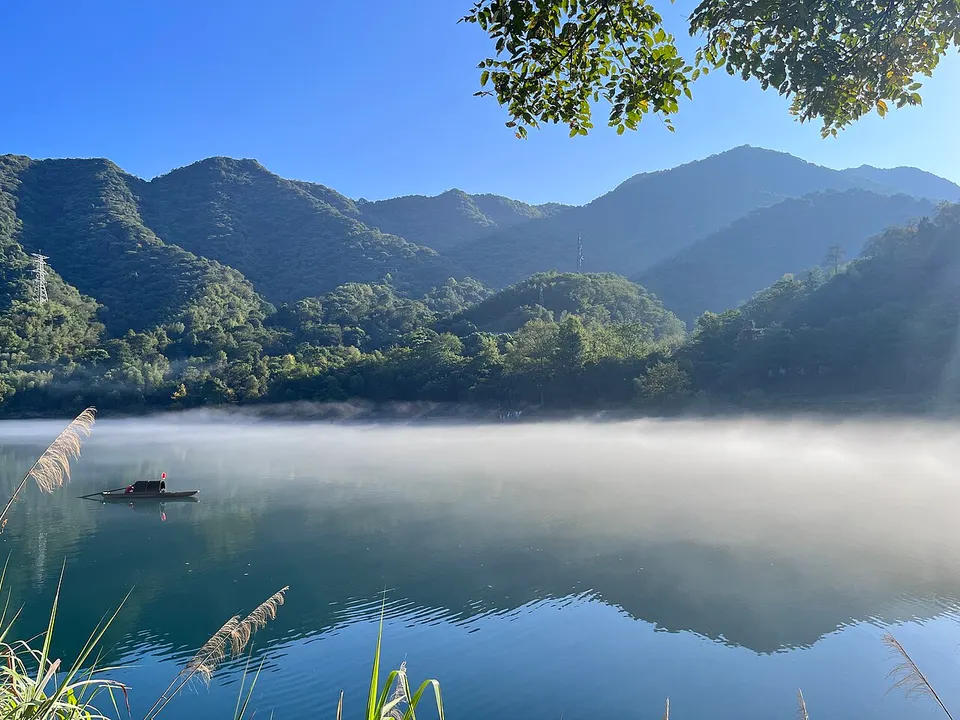
Mist on Dongjiang Lake and red Danxia hills on the road to Guangdong
About Chenzhou
Chenzhou fills the south-east corner of Hunan, where the Nanling ranges reach the borders of Guangdong and Jiangxi, and the character of its name, Chen, is used for no other place. East of the city, Dongjiang Lake is a large reservoir at Zixing, and mist often hangs over its narrow Xiaodongjiang arm. Mangshan's old-growth forest climbs the Guangdong border, the red Danxia cliffs of Gaoyi Ridge rise nearby, and Suxian Ridge is tied to the Han legend of Su Dan, who became an immortal.
What to eat in Chenzhou
- Linwu duck (临武鸭)
Listed sites in Chenzhou
29 sites in Chenzhou are on the official lists. Those with a page of their own link to it; the rest open as cards on the map.
- Dongjiang Lake 东江湖 5A scenic area
A reservoir of about 160 km² among the hills of Zixing, held back by a 157 m double-curvature arch dam on the Lei River that was built in stages between 1958 and 1992. - Banliang Ancient Village 板梁古村 4A scenic area · National heritage site · on the map
A Liu-clan farming village in Gaotingsi town, Yongxing County, first built in 1358, whose lanes of grey-brick houses, ancestral halls and gateways survive largely from the Ming and Qing; 29 old buildings make up the national heritage group, among them the Upper Village Ancestral Hall of 1443 and the early-Ming Lower Village hall. - Baoshan National Mine Park 宝山国家矿山公园 4A scenic area · on the map
A mine park on Baoshan hill on the western edge of Guiyang county town, set up by the Baoshan non-ferrous metals company on a hill mined since ancient times. - Feitian Mountain 飞天山 4A scenic area · on the map
A national geopark of red Danxia sandstone north-east of Chenzhou, where a river winds between cliffs and rock towers weathered into shapes likened to people and animals. - Fuquan Hot Spring Resort, Rucheng 福泉山庄 4A scenic area · on the map
A hot-spring resort at Reshui ('hot water') town in eastern Rucheng, near the Jiangxi and Guangdong borders, built over a geothermal field whose springs reach 91–98 °C, among the hottest in southern China. - Gaoyi Ridge 高椅岭 4A scenic area · on the map
A Danxia landscape of red sandstone cliffs and ridges on the border of Suxian District and Zixing, north-east of Chenzhou, covering about 50.5 km². - Huilong Mountain 回龙山 4A scenic area · on the map
A mountain of about 1,413 m north of Dongjiang Lake in Zixing, rated 4A in December 2024 and visited for sunrise, sunset and sea-of-cloud views from the top and for wild azaleas in May. - Jiulongjiang National Forest Park 九龙江国家森林公园 4A scenic area · on the map
A national forest park on the former Daping state forest farm in south-eastern Rucheng County, on the Hunan–Guangdong border, covered mostly in natural broadleaf forest and rising to Fuyin Peak (1,381 m). - Longnü Hot Spring 龙女温泉 4A scenic area · on the map
A hot-spring resort area at Tongkenghu on the north-western edge of Chenzhou, near National Road 106, built around a carbonated spring at about 40 °C used for both bathing and drinking. - Mangshan National Forest Park 莽山 4A scenic area · on the map
A large mountain forest at the southern tip of Yizhang County on the Hunan–Guangdong border, protected as a national nature reserve and national forest park; its subtropical forest has species named after it, such as the Mangshan pit viper. - Shazhou Village (Half a Quilt Story) 沙洲村 4A scenic area · on the map
A Yao village in western Rucheng County known for the 'half a quilt' story: in November 1934, as the Central Red Army crossed the area on the Long March, three women soldiers who lodged with a villager, Xu Jiexiu, cut their only quilt in two and left her half. - Suxian Ridge 苏仙岭 4A scenic area · National heritage site · on the map
A wooded hill on the north-eastern edge of central Chenzhou, named after the legend of a local man who became an immortal ('Su the Immortal'); paths climb past the White Deer Cave, the 'Ascension Stone' and other spots tied to the story. - Tiantang Hot Spring 天堂温泉 4A scenic area · on the map
A hot-spring resort at Tiantang village in Xujiadong, on the northern edge of Chenzhou, developed in the 2000s around a spring that comes up at about 52 °C. It has Japanese-style open-air pools in landscaped grounds, with a hotel and villas on site, and suits a relaxed half day or an overnight stay. - Wangxian Ridge 王仙岭 4A scenic area · on the map
A forested hill scenic area on the south-eastern edge of Chenzhou city, with walks among streams and small waterfalls under the trees. - Wanhuayan Cave 万华岩 4A scenic area · on the map
A limestone show cave in the south-western outskirts of Chenzhou, in Beihu District, where lit paths lead past stalactites, stalagmites and flowstone, and the walls carry inscriptions left by visitors from the Song dynasty onwards. - Wanyang Mountain 万洋山 4A scenic area · on the map
A mountain scenic area in Guidong County near the Jiangxi border, part of the Luoxiao range, whose high meadows above 1,500 m, natural tarn and lines of wind turbines are marketed as a 'southern grassland'; azaleas flower on the slopes in spring. - Xiyao Green Valley National Forest Park 西瑶绿谷 4A scenic area · on the map
A national forest park, set up in 2010, in the Xishan Yao Township of south-western Linwu County, where forested mountains fall from 1,720 m to about 300 m into deep valleys with streams, waterfalls and caves. - Yangtianhu Grassland 仰天湖大草原 4A scenic area · on the map
A high grassland of rolling hilltops at around 1,300 m in the mountains south-west of Chenzhou, in Beihu District. - 711 Uranium Mine Heritage Site 核工业711功勋铀矿旧址 National heritage site · on the map
The site of China's first large uranium mine to be found and worked, at Xujiadong north of Chenzhou: an airborne survey found the deposit in 1956, production began in 1963 (as Mine 711 from 1964), it supplied uranium for China's first atomic bomb, and mining ended in 1994. - Ancient Ancestral Halls of Rucheng 汝城古祠堂群 National heritage site · on the map
Rucheng County keeps more than 700 clan ancestral halls, the oldest from 1231 and most of them Qing, and nine, from the Ming to the Republic, form this national heritage group. - Former Residence of Deng Zhongxia 邓中夏故居 National heritage site · on the map
The birthplace of Deng Zhongxia (1894–1933), an early member of the Chinese Communist Party and leader of the labour movement, including the Canton–Hong Kong strike of 1925–26, who was captured and executed by the Nationalist government in 1933. - Headquarters of the South Hunan New Year Uprising 湘南年关暴动指挥部旧址 National heritage site · on the map
A Qing courtyard compound at 26 Zhongxia Street in Yizhang county town, built under the Shunzhi emperor as the garrison commander's office and later a girls' vocational school, which Zhu De and Chen Yi used as their headquarters for the 'New Year' rising of January 1928 that opened the Xiangnan (South Hunan) Uprising. - Long March Third Blockade Headquarters Site 中央红军长征突破第三道封锁线指挥部旧址 National heritage site · on the map
The Kuang clan ancestral hall (Qingbai Tang) in Baishidu village, a two-storey brick-and-timber hall with fire-gable walls built in 1861. - Mausoleum of Emperor Yi 义帝陵 National heritage site · on the map
The tomb of Xiong Xin, Emperor Yi of Chu (died 206 BC), the figurehead ruler of the rebels against the Qin, whom Xiang Yu sent away to Chen County (today's Chenzhou) and had murdered; the people of Chen buried him here, in what is now the middle of the city. - Old Kunqu Opera Stages of Guiyang 湘昆古戏台 National heritage site · on the map
Three Qing-dynasty theatre stages built into clan ancestral halls in villages of Guiyang County, linked with Xiang Kun, the local Hunan branch of Kunqu opera: the Luo clan hall stage at Daxi (1653, restored 1854), the Ouyang clan hall stage at Xiayang (1718) and the Wei clan hall stage at Zhaojin (1863). - Shilangtan Cliff Inscriptions 侍郎坦摩崖石刻 National heritage site · on the map
A red-sandstone overhang about 12 m high and 150 m long on the north bank of the Bian River, as the Lei River is called in Yongxing, named 'the Vice-Minister's Overhang' after the Tang writer Han Yu, who moored his boat here. - Site of the Fourth Red Army Front Committee Meeting 红四军前委扩大会议旧址 National heritage site · on the map
The Tang family house (Tangjia Dawu) in Guidong county town, with the adjoining City God Temple, where in 1928 the forces of Mao Zedong and Zhu De held an enlarged meeting of the Fourth Red Army's front committee after the setback known as the 'August Defeat'. - Xiangnan Uprising Memorial Hall and Sites 湘南起义纪念馆 National heritage site · on the map
The Xiangnan (South Hunan) Uprising of January–April 1928, led by Zhu De and Chen Yi, briefly put more than ten counties of southern Hunan under communist control before the troops withdrew to join Mao Zedong at Jinggangshan; the national heritage group covers buildings linked to it in ten counties. - Xiuyi Arch 绣衣坊 National heritage site · on the map
A white stone memorial arch of 1519 at the entrance to the Fan family village of Yidao, on the edge of Rucheng town, raised for the censor Fan Lu ('embroidered robe' was a name for imperial censors), who was jailed after denouncing the Prince of Ning's dealings with eunuchs and cleared when the prince rebelled.
On the map
Open Chenzhou on the illustrated map to see its outline, its places and listed sites together, and to add them to a trip.
Open Chenzhou on the map