 Atlas of China
Old Tea Forests of Jingmai Mountain 景迈山古茶林Jǐngmài Shān Gǔ Chálín
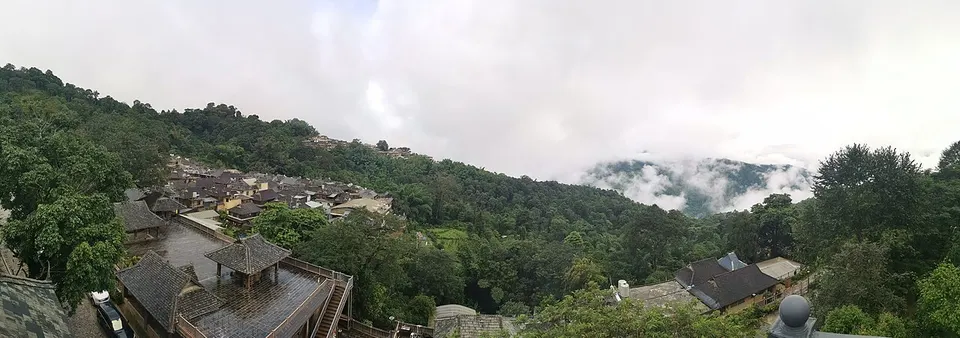
Ancient tea trees grown beneath the forest canopy around Blang and Dai villages
- Best time
- Mar–Apr (spring tea picking), Oct–Nov
- Time needed
- 1–2 days
- Days to budget
- 2 days
- Stay in
- Lancang
- Region
- Yunnan
- Type
- Culture
- Listed as
- 4A scenic area, National heritage site, UNESCO World Heritage
Why go to Old Tea Forests of Jingmai Mountain
On a forested ridge in Lancang county, in Pu'er prefecture, old tea trees grow scattered beneath taller forest trees instead of in clipped rows. Nine traditional Blang and Dai villages of wooden stilt houses sit among five old tea forests, and in 2023 the landscape became the world's first tea-themed World Heritage Site. Walk the forest paths, drink the local Pu'er tea in a village tea house and stay the night to watch the mist lift off the hills.
The story
Blang oral tradition tells that their leader Pa Aileng brought his people here around the 10th century, found that tea leaves cured the sickness they had caught on the way, and taught them to grow it; he is still honoured as the 'tea ancestor'. In each plot the first tree planted is a 'tea spirit tree' that must never be cut, and offerings are made to the spirits before the spring picking.
What to see at Old Tea Forests of Jingmai Mountain
- Jingmai Dazhai 景迈大寨: A Dai village of wooden stilt houses among old tea trees, regarded as the first village the Dai settled on the mountain.
- Nuogang village 糯岗: A Dai village of wooden stilt houses set among old tea trees on the Jingmai side of the mountain, protected as a national heritage village.
- Wengji village 翁基: A Blang village on the Mangjing side, among the tea forests, with a Blang-culture focus for visitors.
- Mangjing upper village 芒景上寨: A Blang village on the Mangjing side of the mountain, among old tea gardens.
How to visit Old Tea Forests of Jingmai Mountain
Villages sit along the ridge on a road you travel by hired car, with short walks through tea gardens between them. Start with Jingmai Dazhai and Nuogang on the Jingmai side, then continue to Mangjing and Wengji on the other side of the mountain. With one day you can see two or three villages; a night lets you catch the dawn mist.
How to get to Old Tea Forests of Jingmai Mountain
Flights from Kunming to Lancang Jingmai Airport take just over an hour, and the villages are a 1–1.5-hour drive from there. From Jinghong in Xishuangbanna it is about 3 hours by car.
Where to stay
Stay in a village guesthouse in Wengji, Nuogang or Mangjing for dawn views and a tea-house evening. Huimin town, on the north side of the mountain, is the nearest town if you prefer more choice.
What to eat
- Pu'er tea 普洱茶: Tea from the old trees of the mountain, one of the six famous tea mountains of Pu'er, served in village tea houses from local leaves.
- Blang sour tea 布朗酸茶: A traditional Blang tea of fermented leaves with a sharp, sour taste, eaten or brewed.
Tips for visiting Old Tea Forests of Jingmai Mountain
- Entry must be booked in advance, per vehicle, through the 'Jingmai Mountain reservation' WeChat mini-program; show the QR code at the Jingmai Bridge checkpoint.
- Public transport is sparse, so hire a car and driver in Lancang or Jinghong, and carry your passport for hotel check-in and roadside ID checks.
- Cloud wraps the mountain for much of the year; stay overnight in a village guesthouse in Wengji or Nuogang to catch it clearing at dawn.
Nearby
- Xishuangbanna & Jinghong 西双版纳与景洪 90 km
Gilded Dai temples, a Mekong-side night market and April's Water-Splashing Festival
Also within 30 km: Laodabao Lahu Village 老达保 (20 km).
On the map
Open Old Tea Forests of Jingmai Mountain on the illustrated map to see the terrain around it, what else is close, and to add it to a trip and plan the days.
Open Old Tea Forests of Jingmai Mountain on the map