 Atlas of China
Jinci Temple 晋祠Jìncí
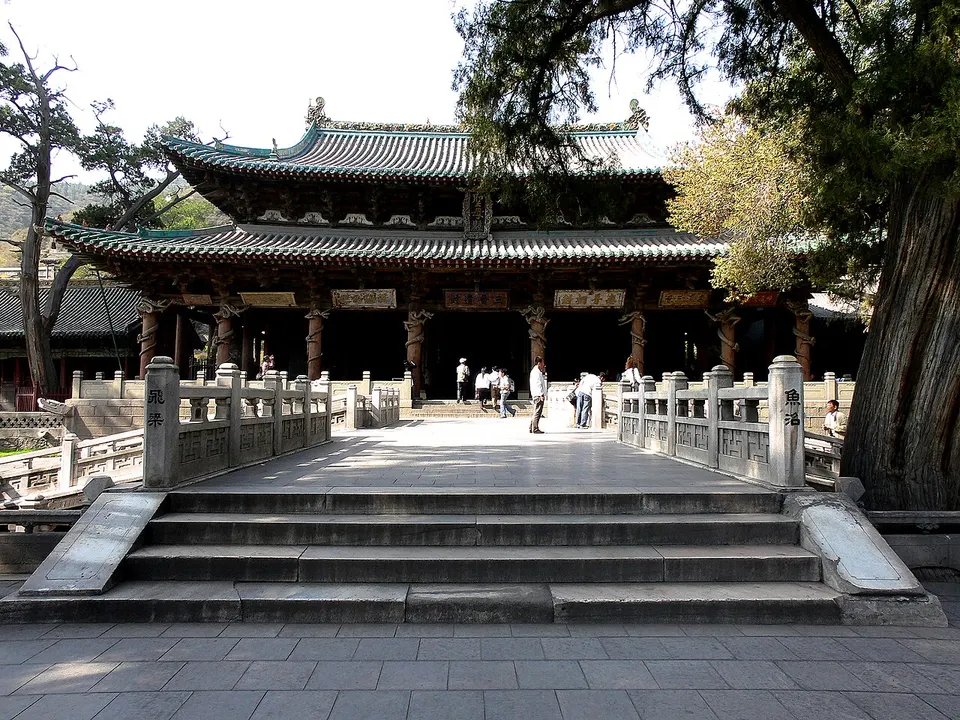
Song-dynasty halls, painted clay maidservants and a cross-shaped bridge at the Jin springs
- Best time
- Apr–May, Sep–Oct
- Time needed
- Half a day
- Days to budget
- Half a day
- Stay in
- Taiyuan
- Region
- Shanxi
- Type
- Heritage
- Listed as
- 5A scenic area, National heritage site
Why go to Jinci Temple
At the foot of Xuanweng Mountain, about 25 km south-west of central Taiyuan, Jinci is a spring-fed complex of shrines, pavilions, bridges and old trees added to over many centuries. Make for the Song-dynasty Hall of the Holy Mother, with wooden dragons coiled around its front pillars and about 40 life-size painted clay attendants inside, then walk over the cross-shaped Fish Pond Flying Bridge in front of it and find the reclining Zhou cypress beside the hall, said to be some 3,000 years old.
The story
Jinci began as a shrine to Shu Yu of Tang, a son of King Wu of Zhou, whose fief, renamed Jin by his son, grew into the state that still gives Shanxi its one-character abbreviation. The historian Sima Qian tells how Yu got his land: his brother, the boy-king Cheng, handed him a leaf as a joking promise of a fief, and the regent, the Duke of Zhou, insisted that a king must keep his word.
What to see at Jinci Temple
- Water Mirror Terrace 水镜台: The old opera stage near the entrance, with big jars buried under the stage floor to carry the sound. A plaque on the side reads 'famous springs of Shanxi'.
- Gold Man Terrace 金人台: Four iron guardian figures about two metres high stand at the corners of the terrace, cast between 1089 and 1098; the north-east one was recast in 1913.
- Offering Hall 献殿: A Jin hall of 1168 with open sides like a pavilion, where offerings were laid out for the Holy Mother. Its light frame has stood for more than 800 years.
- Fish Pond Flying Bridge 鱼沼飞梁: A rare cross-shaped stone bridge carried on 34 octagonal pillars over a square pond. Two Song iron lions of 1118 guard the approach.
- Hall of the Holy Mother 圣母殿: Begun in the 1020s and rebuilt in 1102, it is the oldest building in the complex. Eight wooden dragons coil round the front pillars, and 43 clay figures, all but two of them Song, fill the interior.
- Nanlao Spring 难老泉: The main source of the Jin River, under a pavilion first built in the Northern Qi in the south of the grounds. The water stays at about 17 degrees Celsius all year, and it flowed freely again from 2023.
How to visit Jinci Temple
Enter by the main gate and pass the Water Mirror Terrace, then follow the central axis west to the Holy Mother Hall, with the Offering Hall and the bridge on the way. Turn south to the Nanlao Spring and the Water Mother Tower. Half a day covers all this; add the Tianlong Mountain grottoes only if you start early.
How to get to Jinci Temple
Taiyuan South station is about 2.5–3 hours from Beijing by high-speed train. From central Taiyuan a taxi to Jinci takes around 40 minutes, and city buses from both railway stations stop at Jinci Park.
Where to stay
Stay in central Taiyuan, where hotels and restaurants cluster, and treat Jinci as a half-day trip by taxi or city bus.
What to eat
- Tounao 头脑: A thick, warming soup of lamb, lotus root, yam and wheat paste, served with rice wine and said to have been devised by the scholar Fu Shan; a Taiyuan cold-season classic.
- Taiyuan shaomei 稍梅: Pleated dumplings of meat in a thin skin, the local take on shaomai.
- Guanchang 灌肠: Slices of buckwheat starch paste, eaten cold with vinegar and garlic or fried hot; a Taiyuan street snack.
Tips for visiting Jinci Temple
- Buy tickets through the scenic area's official WeChat account or at the ticket office, and ignore taxi drivers offering 'guide' packages that bundle tickets with the fare.
- The general ticket for the Jinci–Tianlong Mountain scenic area also covers the Buddhist grottoes on Tianlong Mountain, reached by a sightseeing bus that stops running in mid-afternoon, so go there first if you want both.
Nearby
- Shanxi Museum 山西博物院 20 km
Bronzes of the ancient state of Jin, Buddhist statues and tomb treasures on the Fen River - Qiao Family Compound 乔家大院 30 km
Walled courtyards of a Qing merchant-banking family, the set for Raise the Red Lantern - Pingyao Ancient City 平遥古城 60 km
An intact Ming walled town of courtyard inns, where China's first draft banks were born - Shuanglin Temple 双林寺 70 km
Some 2,000 painted clay Buddhas, saints and guardians crowded into ten temple halls - Mount Mian 绵山 100 km
Cliff temples, plank walkways and gorges on the mountain of the Cold Food legend - Wang Family Compound 王家大院 100 km
Fortified courtyard 'castles' of a Qing merchant and official clan on a loess hillside
Also within 30 km: Longshan Grottoes and Tongzi Temple Site 龙山石窟·童子寺遗址 (under 10 km), Mingxiu Temple 明秀寺 (under 10 km), Jinyuan Confucian Temple 晋源文庙 (under 10 km), Longquan Temple, Taishan 太山龙泉寺 (under 10 km), Taiyuan Botanical Garden 太原植物园 (under 10 km), Jinyang Ancient City Site 晋阳古城遗址 (under 10 km).
On the map
Open Jinci Temple on the illustrated map to see the terrain around it, what else is close, and to add it to a trip and plan the days.
Open Jinci Temple on the map