 Atlas of China
Kumbum Monastery 塔尔寺Tǎ'ěr Sì
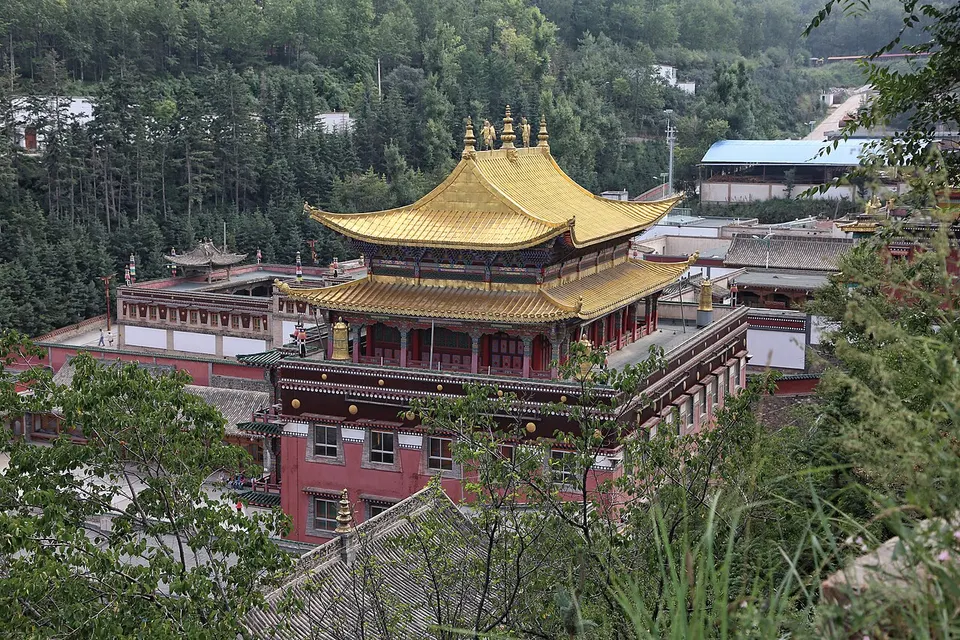
Golden roofs and butter sculptures at the birthplace of Tsongkhapa
- Best time
- Apr–Oct; Feb for the butter sculpture festivals
- Time needed
- Half a day
- Days to budget
- Half a day
- Stay in
- Xining
- Region
- Qinghai
- Type
- Culture
- Listed as
- 5A scenic area, National heritage site
Why go to Kumbum Monastery
Kumbum is one of the six great monasteries of the Gelug school of Tibetan Buddhism, set on a hillside in Lusar town, Huangzhong District, built where the school's founder Tsongkhapa was born. Some 200,000 square metres of halls, colleges, residences and stupas climb the slopes, mixing Tibetan and Han styles, and the monastery is best known for its butter sculptures, murals and appliqué work. It is still a working monastery, so you share the lanes with monks and pilgrims.
The story
Tsongkhapa (1357–1419) was born in the valley, and a small temple with a stupa raised by his mother in the 14th century marks the spot. Legend says a sandalwood tree sprang up where his birth blood fell, its leaves bearing images of the Buddha; the name Kumbum is usually glossed as 'a hundred thousand images'. The monastery proper was completed in 1583 and grew into a major centre for Tibetan and Mongolian pilgrims.
What to see at Kumbum Monastery
- Eight Stupas 八宝如意塔: Eight white stupas stand in a row in front of the entrance, the first thing you see on arrival. They are said to commemorate the eight great deeds of the Buddha.
- Great Golden Tile Hall 大金瓦殿: The monastery's holiest building, a golden-roofed hall built around the spot of Tsongkhapa's birth, with a stupa inside said to hold sections of the legendary sacred tree. Pilgrims prostrate on the porch outside.
- Great Hall of Sutras 大经堂: The biggest hall in the complex, where monks gather to chant and study. Pillars wrapped in woven rugs and walls hung with painted scenes of Buddhist stories give it a rich, dim interior.
- Butter Sculpture Hall 酥油花院: Home to the butter sculptures, in which monks model coloured yak butter into flowers, figures and scenes from Buddhist stories. Together with the murals and the silk appliqué hangings seen in the main halls, they are known as the monastery's 'three arts'.
How to visit Kumbum Monastery
Enter by the main gate past the Eight Stupas and follow the lanes uphill through the monastery's courtyards, taking in the Great Golden Tile Hall and the Great Hall of Sutras first, then the butter sculpture hall and the smaller colleges. Allow 2–3 hours for the main sights; a half-day lets you linger over the art and the pilgrims' circuits. Go early in the day for softer light and fewer tour groups. Weekends and festival days are the busiest.
How to get to Kumbum Monastery
The monastery is in Lusar town, about 26 km south-west of central Xining, 40 minutes to an hour by taxi or car. Local buses and tour minibuses also run from Xining; ask your hotel for the current pick-up point.
Where to stay
Base yourself in Xining, where hotels and the Dongguan area's eateries are concentrated; the monastery is an easy half-day trip. Lusar town at the monastery gate has a few guesthouses if you want an early start.
What to eat
- Hand-grabbed mutton 手抓羊肉: Boiled mutton on the bone, eaten by hand with salt, a staple of Xining's Hui restaurants.
- Xining yoghurt 西宁老酸奶: Thick, lightly sweet local yoghurt, served in small bowls and often had for breakfast.
- Niangpi 酿皮: Chilled, chewy steamed starch sheets in a tangy chilli and vinegar dressing, a popular Xining street snack.
Tips for visiting Kumbum Monastery
- Dress modestly (shoulders and knees covered), keep your voice low, and expect photography to be banned inside the halls; look for signs and ask a monk if unsure.
- Walk clockwise around shrines and stupas, as pilgrims do.
- The butter sculptures on show are made for the Lantern Festival on the 15th day of the first lunar month; displays and what is open vary by season, so ask on arrival. Xining sits at about 2,200 m and the monastery higher, so take it easy on the slopes.
Nearby
Also within 30 km: Qinghai Tibetan Culture Hall 青海藏文化馆 (under 10 km), Xinhualian Tongmeng Park 新华联童梦乐园 (20 km), Western Route Army Memorial Hall, Xining 中国工农红军西路军纪念馆 (20 km), Qinghai-Tibet Plateau Wildlife Park 青藏高原野生动物园 (20 km), Nanliang Hutai Site 虎台遗址 (20 km), Qinghai Provincial Museum 青海省博物馆 (20 km).
On the map
Open Kumbum Monastery on the illustrated map to see the terrain around it, what else is close, and to add it to a trip and plan the days.
Open Kumbum Monastery on the map