 Atlas of China
Cuandixia Village 爨底下村Cuàndǐxià Cūn
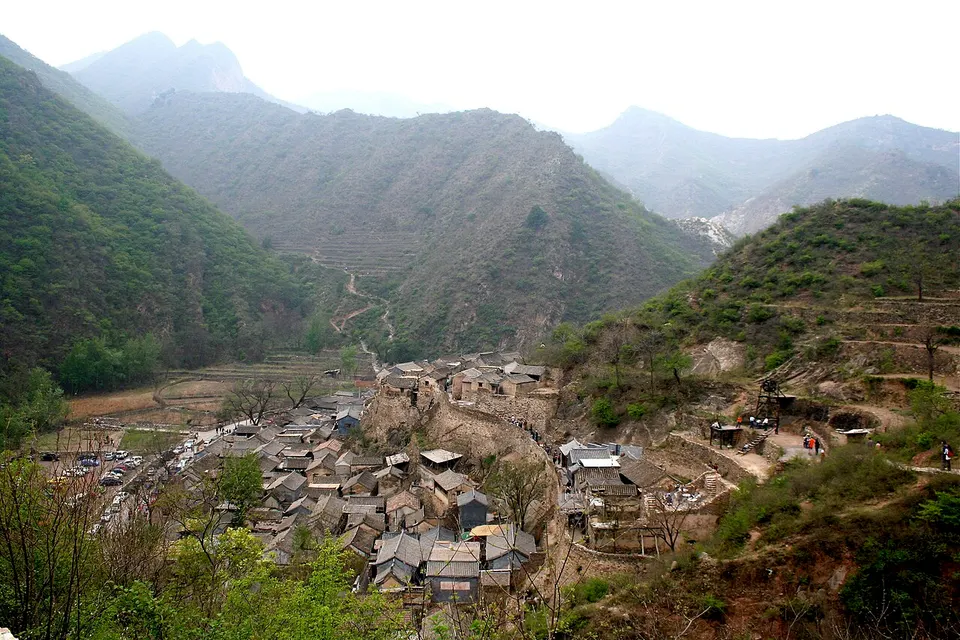
Ming and Qing courtyard houses stacked in tiers up a hillside in the western mountains
- Best time
- Apr–May, Sep–Oct
- Time needed
- Most of a day
- Days to budget
- 1 day
- Stay in
- Beijing
- Region
- Beijing
- Type
- Culture
- Listed as
- National heritage site
Why go to Cuandixia Village
In the mountains of Mentougou District, about 90 km from central Beijing, Cuandixia is a village of more than 70 Ming- and Qing-era courtyard houses rising in tiers up a slope, linked by stone-paved lanes and steep steps. Wander the lanes for carved brick, stone and wood details and the old family maxims and slogans on the walls, then stop for a meal in one of the courtyards that now serve as family-run restaurants and inns.
The story
The village was founded during the Ming dynasty's Yongle reign (1403–1424) by a family surnamed Han who moved here from Shanxi, and the villagers have traditionally all shared that name. It takes its name from the Ming-era Cuanli'ankou pass above it; cuàn, meaning a cooking stove, is such a rare and complex character that simpler ones are often written in its place.
What to see at Cuandixia Village
- Stone lanes and steps 石板街巷: The paved alleys and steep stone staircases that link the tiers of houses, and give the village its shape.
- Carved courtyard details 砖雕石刻: Stone, brick and wood carving across the houses, with bats, peonies and water lilies as common motifs.
- Caizhuyuan courtyard 财主院: One of the grander courtyards, a prosperous family's house showing the village's trade wealth in coal, fur and grain.
How to visit Cuandixia Village
Buses stop at the village entrance, so walk up the main lane and then branch into the side alleys. Two to three hours is enough to see the houses; staying for lunch in a courtyard restaurant makes it a half day, and an overnight stay lets you see the lanes at dawn.
How to get to Cuandixia Village
From Pingguoyuan station (Metro Lines 1, 6 and S1), take bus 892 or M22 to Zhaitang and change to the M12 mountain bus, which stops at the village; by car, allow about 2 hours each way from central Beijing.
Where to stay
Stay in one of the courtyard inns in the village itself for early-morning and evening quiet, or in the nearby town of Zhaitang if they are full.
What to eat
- Free-range chicken with mushrooms 柴鸡炖蘑菇: Farm chicken slow-cooked with local mountain mushrooms, a hearty village dish.
- Stir-fried wild mushrooms with pork 山蘑炒肉: Mountain mushrooms stir-fried with sliced pork, using produce from the surrounding hills.
Tips for visiting Cuandixia Village
- Mountain buses run only a few times a day and are suspended in snow, heavy rain or high wind, so check the day's service and the last bus back before setting out.
- Stay overnight in a courtyard inn to see the lanes in the early morning and evening, which are also the best times for photographs.
- For the classic view over the tiered rooftops, climb nearby Jinchan Hill.
Nearby
- Tanzhe Temple 潭柘寺 30 km
Terraced temple courtyards in the western hills, shaded by ancient ginkgos and cypresses - Zhoukoudian Peking Man Site 周口店北京人遗址 40 km
Limestone caves on Dragon Bone Hill where the fossils of Peking Man were found - Fragrant Hills Park 香山公园 50 km
Wooded former imperial hills that turn red with smoke-tree leaves each autumn - Badaling Great Wall 八达岭长城 50 km
Ming ramparts climbing both ways from a fortified pass, a short fast train from Beijing - Marco Polo Bridge 卢沟桥 50 km
An 800-year-old stone bridge lined with hundreds of carved lions, by a walled Ming fort - Summer Palace 颐和园 50 km
An imperial lakeside garden of painted corridors, temple-topped hills and a marble boat
Also within 30 km: Lingyue Temple 灵岳寺 (under 10 km), Shenglian Mountain 圣莲山 (20 km).
On the map
Open Cuandixia Village on the illustrated map to see the terrain around it, what else is close, and to add it to a trip and plan the days.
Open Cuandixia Village on the map